I have a rule.
On a 3-day vacation you do not eat at the same place twice. Too much to taste. Too little time. This trip to Goa, I broke it. And oh boy, am I glad.
Here is the kicker. I am vegetarian. One or two bites of the non-veg, no more. At Oya’s Umami I cannot touch more than half the menu. I went back anyway. Read that again. A vegetarian, returning to a Naga kitchen that runs on pork, beef, smoked meat. That is the review in one fact.
Let me sit on that fact a second. It is the whole point. The job of a restaurant is to feed you. The job of a great one is to make you want to come back. Most places get the first part right and miss the second. Oya’s flipped it on a man who could only order the corners of its card. I walked in, able to eat maybe eight things on the menu (apart from Diet Coke). I walked out plotting the second visit. That does not happen by chance. That happens when a kitchen cooks for the plate, not the headcount.
We found it by mistake. We wanted a place within a kilometre of Starbucks. Of course we did. The coffee chain that I ironically call home. We walked Miramar with a phone and a craving and no plan, and Oya’s appeared the way the good ones always do. Off the main drag. No queue spilling onto the road. No neon screaming for you. We reached, and the place pulled us in before the food got a chance.
It screamed taste. Not the palate kind. The other one. The taste we startup kinds talk about. The judgment you feel the second you walk in. The decor. The books on the shelf. The postcards. The posters, down to a framed “Hasta la vista baby” sitting next to a constellation in a paisley frame. Paper lanterns hung like folded moons. White tile. Wood that has taken some years and wears them well.
Taste, the second kind, is a tell. You can fake a logo. You can buy a fit-out off a Pinterest board. You cannot fake the third book on the shelf, or the postcard nobody was meant to notice, or the depth in a film poster on a Naga restaurant wall. One of the posters is the Leo constellation (cos the chef is a Leo; I have no way to validate. Maybe I will next time I am there). Those are choices a person made for no audience, because they could not help themselves. That is the signal I trust. A room put together with that much care is almost never followed by careless food. The hand that picks the posters picks the chillies.
Then you learn who built it, and the room makes sense. The Internet tells me that Imli Ati Aier (though not sure) carried her Naga kitchen from Delhi and ran it out of her home for six years before it earned four walls. Six years of cooking for people who came to her table, not a storefront. The doors opened in Panjim in 2025. It still cooks like a home kitchen that ran out of space and had to rent some. Seven tables. 350 square feet. Thirty-five people if everyone breathes in. You do not get seated at Oya’s. You get admitted.
Naga food does not ask for permission. It shows up smoked, fermented, chilli-loaded, and it dares you to keep up. The pantry behind it reads like a survival manual. Bhut jolokia, the ghost chilli, one of the hottest things on the planet. Dried shrimp. Fermented crab. Anishi, the fermented taro leaf that smells like a dare. A house chilli oil that carries half of that in one spoon. None of this is decoration for a reel. Heck I didn’t know about most of these things. I had to search, use AI and then make some judgement calls.
This is how a hill cuisine kept itself alive before the fridge, and chose to taste like something while it survived. You sit on a beach in Goa and eat a place that lives 3,000 kilometres north. It travels without apology.
And then it made us scream with the other taste. The food.
The hero, for a man who eats green: a charred cabbage wedge, blackened to the colour of an old kettle, in a rust-orange gravy with bamboo shoot and ferment under it. A stone cup of bean-and-herb relish on the side. Raw, green, sharp. You drag the black crust through the orange. Smoke first. Then heat that arrives and stays. This is the plate I keep thinking about.
See this…
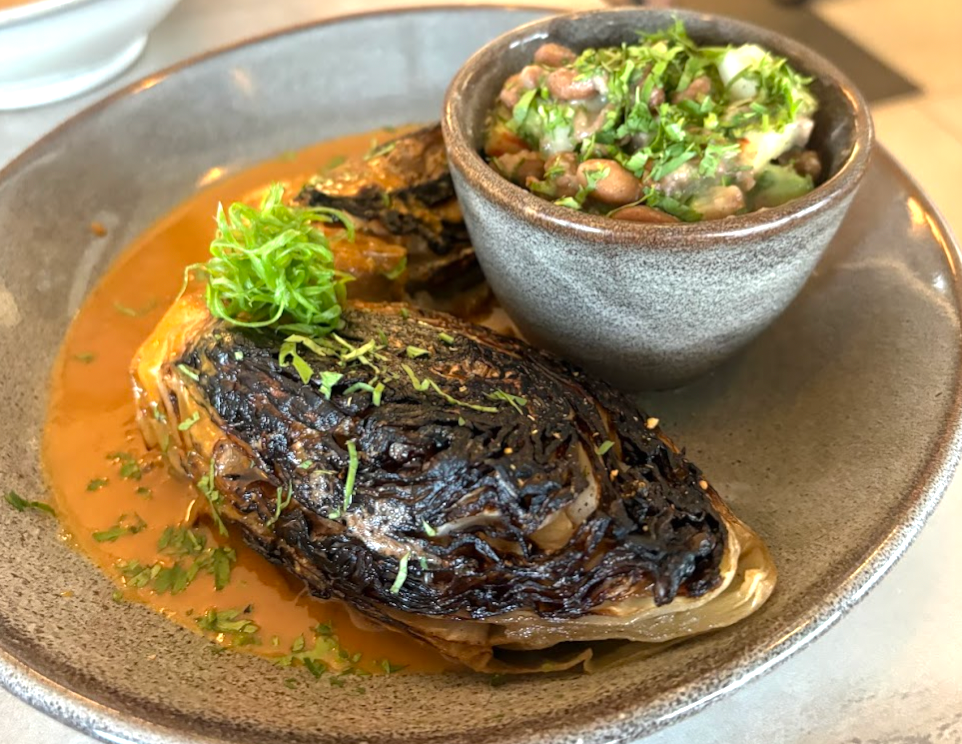
A cabbage. Sit with that. The most boring vegetable in the Indian fridge. The only time I’ve enjoyed it is when I am on a strict Keto. It is the one that turns up at weddings as a damp afterthought between the paneer and the dal. Here it gets fire, patience, and a sauce with a spine. It comes out tasting like the best thing the meat-eaters at the table did not order. That is the real test of a kitchen, whether it respects the person who eats green. Not a paneer reflex. Not a grilled-veg platter built out of guilt and a grill pan. A vegetable treated as the main event, because someone in the back believed it could carry one.
Then the pork loins in a dark sesame gravy. I did my two bites. The plate still came back empty but for one, smears of sauce where the rest had been. A table does not wipe a plate it did not love.
There was heat on that table that I felt the next morning. I do not say that as a complaint. I say it the way you talk about a good argument with a friend. It stayed with me. It earned the space it took up. Most food is forgotten by the time the bill arrives. This food followed me to breakfast.
Let me be honest about the math. About 3000 for two of us. Seven tables. None of this scales. None of it wants to. The Indian restaurant business spends its life turning one good cook into forty outlets and a master franchise, then acts surprised when the food goes tired and the soul checks out. Oya’s does the reverse. It guards its smallness like a recipe. I hope it rather turns you away tonight than serve you a thinner version of itself next year. In a country addicted to growth, holding your size on purpose is almost a political act.
We were greeted by Khushi and a gent whose name I have forgotten. The warmth was real. Not the trained, scripted, name-on-a-lanyard kind. The kind that makes 350 square feet and seven tables feel like someone’s home. Because it sits close to one.
You can measure a place by how it treats you when you are not yet a transaction. Nobody rushed the table. Nobody upsold a dessert. They watched a vegetarian read a menu built for carnivores and steered me, without fuss, to the dishes that would land. That is hospitality. The rest is just service with a smile bolted on.
This is how food has to be. Cooked by someone who means it. Served by someone glad you walked in.
It reminds me of Nicky M‘s burgers. Same DNA. Small. Made by hand. Made with love. Made for a commune, not a chain. That is the thing I live for. Not the forty-outlet, master-franchise machine. One person. One room. One thing done with everything they have.
I keep landing on that word. Commune. The best food I have eaten was never the most expensive. It was the most personal. A kitchen that cooks for a small circle, and lets you into it, does something a chain can never buy back later. It says: I made this for people, not for scale. You taste the difference because there is one. Love does not show up as a line item on a menu. It shows up in whether the cabbage got fifteen extra minutes on the fire, because the cook could not bring herself to send it out any other way.
So I broke my rule. Three days, one repeat, no regret. The rule exists to chase variety. Variety is overrated once you have found the thing. Going back was not laziness. It was respect. Some places you taste once and tick off. A few you return to, to check they were as good as your memory swears. Oya’s was real both times. Same heat. Same warmth. Same cabbage that has no business being that good.
If you are in Panjim, do yourself a favor and drop by to Oya’s and maybe, send me a postcard? They’ve got some handpainted ones for you to pick from.
Links: Insta, Google Maps
PS: This was written by Chandni and Me. Two of us happened to be in Goa when we visited this restaurant.