Walk into any Starbucks and ask the barista where the coffee comes from.
You will get a story. Origin, roast, the farmer, the year the company started buying from that region. Now walk out, go to the next Starbucks, and ask the same question. Same story. Same words. Same pauses. Do it a third time in a third location and you will start to feel like you are in a play with a script that nobody handed you.
If you are in India, do the same at Blue Tokai and Third Wave. Ask the barista where the coffee comes from. One of them will know. One will point at the packet. One will say “sir I will check.” Three outlets, three stories. Sometimes no story.
Stay with me on that. Lets move ahead.
The short answer
A founder personal brand is the story about the founder that other people can tell when the founder is not in the room. You build one in five steps…
- dig out the real origin story
- draw its shape
- write it at three lengths
- rehearse it until it survives a 3am wake-up
- then hand it to your first ten hires so they tell it in the same words
Founders who did this well: Sara Blakely, Nithin Kamath, Satya Nadella. Founders whose brand outran the business: Elizabeth Holmes, Adam Neumann, Byju Raveendran. The rest of this piece, about 10,000 words, is the how, the shapes the storytellers drew, and the examples, good and bad. Skip to the questions at the end if you want the fast version.
Forget the LinkedIn banner. Forget the podcast tour. Forget the overtly visible jacket, though we will get to the jacket. A founder’s personal brand is the story about the founder that other people can tell when the founder is not in the room. I am repeating it and I have built a practice around that one sentence. The barista test. If your first ten hires cannot tell your story in the same words, with the same beats, you dont have a brand yet. You have a person with a following.
I have spent a chunk of the last few years in the room with founders, helping them find that story. Some took it to investors. Some ignored everything I said and did fine anyway. This is what I know, what the storytellers knew before me, and a long list of people who got it right and wrong in public.
So, lemme start with a definition.
What the thing is…
In September 2019 I sat with Ashish (a classmate from MDI and he runs Perfect Group). I wrote it up that week and the post still gets read. He runs money. Value investing, Perfect Group, the family business he walked into after an MBA and a stint at Goldman. I expected to learn about compounding. I came out with a lecture on personal brand that I have not been able to improve on since.
Here is the line I wrote that week, and I stand by it: your personal brand is the sum total of your reputation, the value of your word, the experiences people have had with you, the after-taste they are left with after they meet you, and the kind of work you do. Quality. Quantity. Timeliness.
Read that again and notice what is missing. Followers. Posts. A colour palette.
Those are outputs. The brand is the residue. Ashish put it in one sentence that I have repeated to every founder since: if you are an entrepreneur, build your personal brand first, and it will rub off on your business. He did that. He built a name in value investing circles before anyone cared what Perfect Group did. Then the name lifted the group.
There is a second half to the definition that Ashish did not say and I have added since. The brand has two parts. One, what people feel about you, and two, what they can repeat.
A feeling that cannot be retold dies with the person who felt it. A story that can be retold travels without you. That is the entire difference between reputation and brand. Reputation lives in the room. Brand walks out of it.
Why founders, and why now
Three reasons. One is old. Two are new.
The old one is Ashish’s. Every opportunity in an information economy arrives because of what someone has heard about you. The client, the hire, the investor, the journalist. They all Google you before they meet you. What they find is your brand whether you built it or not.
The first new one is data. Edelman and LinkedIn ran a study in early 2024 on what they call thought leadership. 3,484 executives, seven countries. 73 percent of the decision makers said they trust it more than marketing materials. 75 percent said it made them research a product they were not considering. And the number that should scare you: only 15 percent rated what they read as very good or excellent. The demand is there. The supply is bad. That is a market.
The second new one is the machine. Anyone can now produce a thousand words that read fine. What are the odds that this piece is also from a machine? Which means a thousand words that read fine is now worth nothing. What the machine cannot produce is the thing that happened to you, in the room you were in, with the person who was there. The scarce asset in 2026 is a specific, true, re-tellable story. Founders have those by the dozen. Just that most have never written one down.
Sara Blakely wrote hers down in 2000 and has not changed it since. She had 5,000 dollars in savings. She cut the feet off a pair of pantyhose to wear under white trousers. She wrote her own patent because the lawyers cost too much. She sold from the trunk of her car. She faxed. Twenty one years later, in October 2021, Blackstone bought a majority of Spanx at a valuation of 1.2 billion dollars, and the press release quoted her saying “I started this company with no business experience and very little money.” The same line. Two decades. Call it discipline. She found the story once and never let anyone in the company tell a different one.
Compare that to the founders you know. Ask them how the company started and you get a different answer on Tuesday than on Thursday. The Tuesday version has a co-founder in it. The Thursday version has a customer. Neither has an inciting incident. Both fade out.
Brand is NOT a content calendar
I am not going to tell you to post every day. I am not going to give you a content calendar. I am not going to tell you that vulnerability is a strategy.
The reason is a founder whose investors told him, in as many words, that his storytelling needed work before the next round. He was fluent. Nobody had asked him the right question.
A posting schedule would have done nothing for him. He needed someone to sit with him for three hours and find the moment he decided to quit everything for his startup. That moment exists. He lived it. He has never said it out loud in a way that a stranger could repeat. Once that moment is on paper, the LinkedIn posts write themselves and the pitch fixes itself and the team has something to say at the coffee machine. Without it, the posting schedule is a man shouting facts into a room.
So this piece is about finding the story, shaping it, rehearsing it until it survives a 3am wake-up, and then handing it to the people around you so they can tell it without you. It is the long version of what I do in founder storytelling engagements, written down so you can do most of it yourself. The distribution part at the end is short, because it is the easy part.
One more thing before the storytellers. I want you to hold a picture in your head for the next nine thousand words. It is the barista. Every rule below is in service of one question: could the barista tell it?
The people who drew the shapes
Kurt Vonnegut submitted a master’s thesis to the University of Chicago anthropology department that said stories have shapes and the shapes can be drawn on graph paper. The department rejected it. Decades later he called it the prettiest idea he ever had, and he drew it on a blackboard for anyone who would watch. See it here.
The drawing is simple. Vertical axis: good fortune at the top, ill fortune at the bottom. Horizontal axis: beginning to end. Now draw a line.
Man in Hole. Somebody gets into trouble, gets out of it again. The line dips and comes back up, and Vonnegut points out it ends higher than it started. “This is encouraging to readers,” he says, and the room laughs, and he is right.
Boy Meets Girl. Somebody finds something wonderful, loses it, gets it back.
Cinderella. Flat and low, then a staircase up as the gifts arrive, a cliff down at midnight, and then the line goes off the top of the chart. Vonnegut noticed that the Cinderella curve and the curve of the New Testament are the same drawing. He said he would not have gotten a degree for that either.
From Bad to Worse. Kafka’s Metamorphosis. Starts low, goes lower, stops.
Which Way Is Up. Hamlet. The line wanders in the middle because we never find out whether the news is good or bad, and that, Vonnegut argues, is why Hamlet is a masterpiece. Life does not tell you which news is good.
In 2016 a team at the University of Vermont fed 1,327 stories from Project Gutenberg into a sentiment analysis and let the computer draw the curves. Andrew Reagan, Peter Dodds, Chris Danforth and two others. The paper is called “The emotional arcs of stories are dominated by six basic shapes.”
Six. Rags to riches, a rise. Tragedy, a fall. Man in a hole, fall then rise. Icarus, rise then fall. Cinderella, rise, fall, rise. Oedipus, fall, rise, fall. Vonnegut had been told there was no science in it. There was. He had been dead nine years when the paper came out.
Why does a founder care about a blackboard drawing from an anthropology dropout?
Because every founder story I have ever heard in a pitch is drawn as a straight line going up. Started, grew, raised, growing, will raise. Flat and rising. There is no such curve in Vonnegut and no such curve in the Vermont data. A line that only rises is a chart. Investors have seen ten thousand charts.
The founders who get remembered are drawn as Man in Hole. Or Cinderella. There is a dip. There is a midnight. The dip is the part you are leaving out because you think it makes you look weak, and it is the only part the listener will retell.
Campbell, and the mistake everyone makes with him
Joseph Campbell published The Hero with a Thousand Faces in 1949. One sentence from it has done more work than the other four hundred pages: “A hero ventures forth from the world of common day into a region of supernatural wonder: fabulous forces are there encountered and a decisive victory is won: the hero comes back from this mysterious adventure with the power to bestow boons on his fellow man.”
See this…
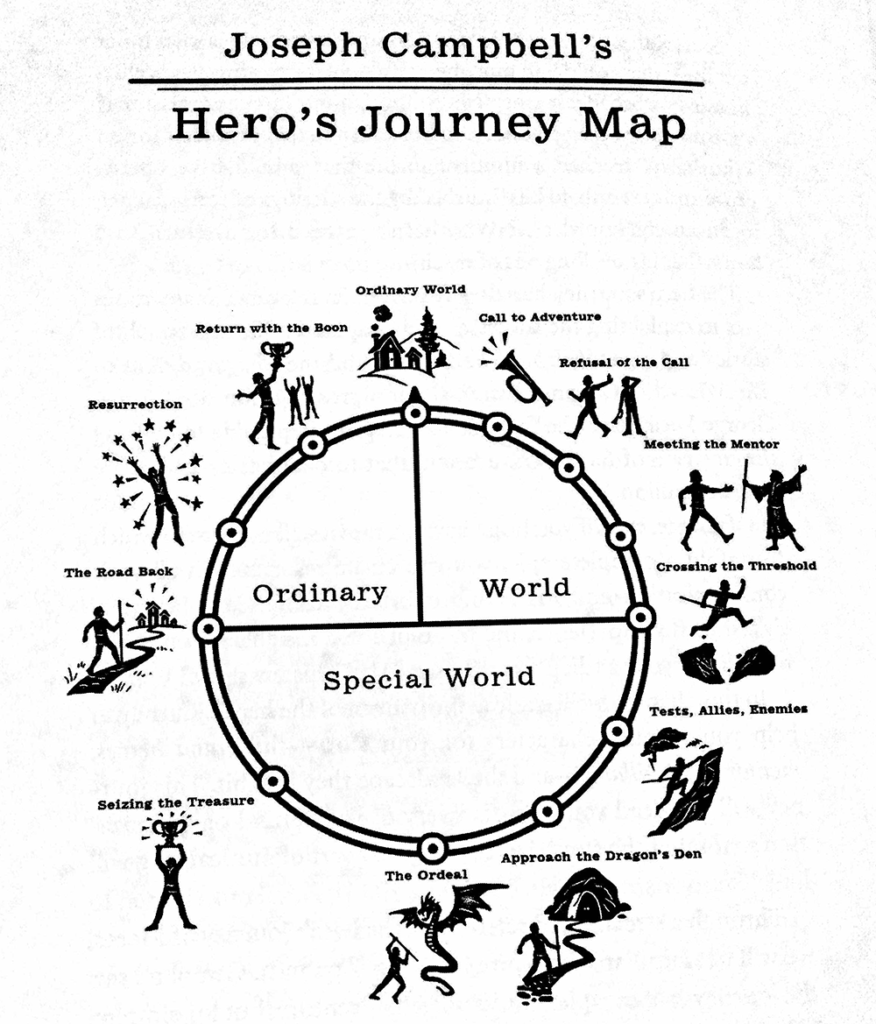
Departure. Initiation. Return. Seventeen stages inside those three. Or 11. Depending on which version you’re reading.
The Call to Adventure. The Refusal of the Call. Crossing the First Threshold. The Belly of the Whale. The Road of Trials. The Ultimate Boon. The Return with the power to help.
Christopher Vogler, then a story analyst at Disney, whose twelve stages I have written about before, boiled Campbell into a seven page memo for screenwriters and then into a book, The Writer’s Journey, with twelve stages. Ordinary World. Call to Adventure. Refusal. Meeting the Mentor. Crossing the Threshold. Tests, Allies, Enemies. Approach to the Inmost Cave. Ordeal. Reward. The Road Back. Resurrection. Return with the Elixir. If you have watched a film made after 1990 you have watched that list.
Dan Harmon, who made Community and Rick and Morty, cut it down further into a circle with eight points. You. Need. Go. Search. Find. Take. Return. Change. A character is in a zone of comfort, wants something, enters an unfamiliar situation, adapts, gets what they wanted, pays a heavy price, returns to the familiar, having changed. Harmon says you can draw it on a napkin, and you can.
Now the mistake.
Founders read Campbell and cast themselves as the hero. Mike Maples Jr and Peter Ziebelman, who wrote Pattern Breakers, have the sharpest line on this: the best entrepreneurs do not mistake themselves for the hero in their story. The story has to be about the early customers, the employees, the investors they are trying to bring along.
Read Campbell again with that in mind. The hero is your customer. The Ordinary World is their life before you. The Call is the problem. The Mentor is you. Obi-Wan does not fly the X-wing. He hands over the lightsaber and gets out of the way.
Where the founder does get to be the hero is in the founder’s own origin story, and even there the arc is the same. Ordinary World: the job, the lab, the family business. Call: the thing you saw that nobody else would fix. Refusal: the two years you told yourself someone else would do it. Threshold: the day you quit. Ordeal: the eighteen months nobody talks about. Return: what you now know that you can hand to others.
Every founder has that arc. Every one. The story is there. The problem is that the founder tells it from the Threshold onward, skips the Refusal because it feels indecisive, skips the Ordeal because it feels weak, and lands on the Boon with no earned weight behind it.
Most founders can tell me where the company name came from. Good. That is a Mentor line. Ask what made them quit everything, what the inciting incident was, and the answer is not ready. It is in there. Nobody has asked in a way that forced it out.
Aristotle, Freytag, and the four-act cousin
Two more from the West and one from the East, and then we go to work.
Aristotle, in the Poetics, said a whole thing has a beginning, a middle and an end, which sounds like nothing until you notice how many founder stories have two beginnings and no end. He also named two moves that every good story has. Peripeteia: the reversal, where the action turns on itself. Anagnorisis: the recognition, where a character goes from ignorance to knowledge. The reversal is the day the big customer walks. The recognition is the day you understand why they walked. Founders have both and tell neither.
Gustav Freytag drew his pyramid in 1863. Exposition, rising action, climax, falling action, resolution. Five parts. Useful for one reason: it tells you the climax is in the middle, not at the end. The founder story that ends on “and then we raised our Series A” has put the climax at the end and has no falling action, no resolution, nothing to hand the listener. Freytag would send it back.
Then there is kishotenketsu. Four acts, from Chinese and Japanese narrative. Ki, the introduction. Sho, the development. Ten, the turn. Ketsu, the conclusion. Notice what is missing. Conflict. There is no villain and no fight. The third act is a twist that makes you reread the first two acts. A lot of Indian founder stories fit this shape better than the Hollywood one. Nobody tried to stop Nithin Kamath from building Zerodha. There was no enemy. There was a turn: the realisation that the industry made money by making people trade more, and that a broker who made money when customers traded less could win. That is a Ten and the company is the Ketsu.
The shapes that sell
Two more drawings, both from people who used them to move money.
Nancy Duarte, in Resonate in 2010, drew what she calls the sparkline. A presentation that works oscillates between what is and what could be. Down, up, down, up, ending on a high she calls the new bliss. She overlaid Martin Luther King’s “I Have a Dream” on it. She overlaid Steve Jobs’s iPhone launch from January 2007 on it. Same shape.
Go back and watch that Jobs keynote. “Every once in a while, a revolutionary product comes along that changes everything.”
That is what could be. Then he describes the state of smartphones, and mocks the keyboards. That is what is. Then the three devices: a widescreen iPod with touch controls, a revolutionary mobile phone, a breakthrough internet communicator. He says the three names again. And again. Then: “These are not three separate devices. This is one device.” That is the gap closing. That is peripeteia in a black turtleneck.
Robert McKee, whose book Story from 1997 has been read by every screenwriter in Los Angeles and by exactly none of the founders I have worked with, has the cleanest single idea of the lot. He calls it the gap. The distance between what the protagonist expects and what happens. Any scene where the protagonist gets exactly what they expect is a scene not worth shooting. In 2003 he told Harvard Business Review that a story is how and why life changes, and that a CEO’s job is to move people to a goal, and the way into people is story.
Your founder story has a gap or it has nothing. You expected the product to sell. It did not. You expected the co-founder to stay. He did not. You expected the pilot to convert. It did, at one tenth the price. The gap is where the listener leans in. Close it too fast and they lean back.
And the smallest tool of all. Emma Coats, then a story artist at Pixar, tweeted 22 rules of storytelling in 2011. Rule four is a fill-in-the-blanks: Once upon a time there was . Every day, . One day . Because of that, . Because of that, . Until finally . Kenn Adams invented it in 1991 as an improv exercise and called it the story spine. It fits on a napkin next to Harmon’s circle.
I make founders fill it in before we do anything else. Eight lines. Most cannot get past “One day” without stopping to think. That pause is the diagnosis. The One Day is the inciting incident, and if it is not on the tip of your tongue, nobody in your company has it either.
How I do it
Here is the process I run with a founder. Five steps. It takes about six weeks if the founder shows up, and forever if they dont. The paid version of it is the six week founder coaching block, and the six weeks are these five steps with me in the room.
1/ Dig.
Two to three hours, recorded, biography style, the same interview I run when I ghostwrite a founder’s book. Childhood, family business or lack of one, first job, first firing, the thing they saw that nobody else saw, the day they quit. I am not looking for the highlights. I am looking for the Refusal and the Ordeal, the two stages every founder skips. I ask the same question four different ways until the real answer falls out. “What made you quit?” gets the LinkedIn answer. “What was the date?” gets a pause. “Who did you tell first?” gets the story.
2/ Draw.
I take the transcript and draw it on Vonnegut’s axes. Where is the dip. Where is midnight. Then I lay Harmon’s eight points on it and find which ones are missing. There is always a missing Take, the price paid. Founders remember the win and forget what it cost. The cost is the credibility.
3/ Write.
Three lengths. Thirty seconds, for the lift. Three minutes, for the first meeting. Fifteen minutes, for the stage and the fundraise. Same story, same beats, same words at the joints. The thirty second version is the hardest and gets written last.
Here is what a thirty second version looks like when it is done. Invented founder, real shape. Once upon a time there was a second generation corrugated box maker in Gujarat. Every day he quoted on price and lost to the plant next door by fifty paise a box. One day a pharma client rejected a full truck for a crush strength failure and he spent a night on the factory floor with a testing rig he had never touched. Because of that, he started publishing crush strength numbers on every quote. Because of that, the buyers who cared about the number stopped asking about the fifty paise. Until finally he was the only box maker in the state whose sales team led with a lab report. Eight lines. One dip, one turn, one proof. His head of sales can say it. So can the man on the corrugator.
4/ Rehearse.
This is the step everyone wants to skip even though its probably the most important one. The founder says it out loud, to me, twenty times. Then to a stranger. Then on video. The founder’s biggest fear at this stage is that a rehearsed story will stop sounding like them. It does not, and I have written about why a captured voice still sounds like you. The test I use is the 3am test. Koi tere ko neend mein utha ke bole, apni company ke baare mein bata, and it should rattle off. Not a performance. A reflex. Blakely has said the pantyhose line so many times it has the same cadence every time! Rehearsal is how you get to natural. There is no other road.
5/ Cascade.
The founder tells the story to the first ten people in the company, in the same words, and asks them to tell it back. Then the chief of staff tells it to the next ten. Concentric circles. Founder, early team, investors, media, the customer who becomes a reference. By the third circle the founder is not in the room and the story still gets told. That is the barista. When a company wants this written down and on the record, for an anniversary or a rebrand or a founder stepping back, it becomes a company story project, and that is a different, longer piece of work.
Six weeks. No content calendar in sight. The content calendar is what you build after, once there is something to say.
The Take: the beat you are leaving out
I want to slow down on step two because it is where the good founders separate from the fluent ones.
Harmon’s sixth point is Take. You got what you wanted. Now pay. In a film it is the mentor dying or the hero losing a hand. In a founder story it is smaller and it hurts more. The co-founder who left. The year with no salary. The product you loved that you had to kill. The customer you fired. The investor who passed with a line you still remember.
Every founder has three of these. Almost none put them in the story. The reason they give me is that investors want confidence. Which is true, and beside the point. Investors have heard ten thousand confident founders. What they have not heard is a founder who can name the cost and is still standing. The Take is what makes the Return believable.
Here is my own.
In 2019 I wrote that I would stand for three things: creative entrepreneurship, startups, and impact. I picked them in an afternoon and called them fuzzy in the same post. A friend told me that same month that nobody knows for sure what I do. Seven years on, my LinkedIn headline reads “Tinkering.” I run a practice that finds founders their one line. I have written about being a generalist as if it were a choice. I have not found mine. I know what works. I have not implemented it.
That paragraph is the most useful thing in this piece for anyone who has heard me give this talk, because it is the part they will remember. Report the gap. Do not grade it. Move on.
Three hashtags
Ashish’s second lesson, and the one people push back on hardest.
Pick three themes you want to be known for, and make each one simple enough that a five year old could repeat it. He called them hashtags. Malala: girls’ education. Bill Gates: software, then global health. Piyush Pandey: advertising, and the moustache. Ranveer Singh: irreverence. Ashish himself: value investing, community.
Then the hard rule. Every single thing you put out has to sit under one of the three. If it does not, it is noise, and noise is what stops the barista from learning the script.
The pushback is always the same. “But I am more than three things.” Yes. Everyone is. The person is bigger than the brand. The brand is the three things the person is willing to be reduced to in public so that a stranger can hold them in one hand. Deepika Padukone is more than three things. Nobody cares. Mother Earth does not revolve around you.
Founders find this hard because the company is one thing and the founder is several. Here is the fix I use. Hashtag one is the company’s problem, stated as a belief. Hashtag two is the founder’s craft, the thing they were good at before the company. Hashtag three is the founder’s obsession outside work that explains the first two. Kamath: retail investors deserve a fair broker. Trading, from the age of seventeen. Fitness, which is where the Zerodha health obsession comes from. Three hashtags. You could draw his LinkedIn from them without looking.
The social object
This is the part founders laugh at until it works.
Picture a founder who goes looking for one jacket. A specific jacket, in the company’s colour, worn to every meeting. That is a smarter brand decision than most founders make all year.
The idea comes from Neil Strauss’s The Game, of all places. Peacocking. Wear one thing that is visible from across the room so that people come to you. The peacock’s tail is a conversation starter the peacock does not have to start. Strip out the pickup artist nonsense and the principle survives: give the stranger a reason to approach before you have said a word.
Milind Soman wears thong chappals. Everywhere. Airports, stages, dinners. It is a conversation every time, and he never has to open it. Piyush Pandey’s moustache did the same job for four decades of Ogilvy. Richard Branson has built fifteen unrelated businesses on a beard, a grin and a willingness to dress as a bride for Virgin Brides in 1996 and stand in Times Square in a bodysuit in 2002. The businesses have nothing in common. The man is the connective tissue, and the man is recognisable at fifty metres.
Steve Jobs had the black turtleneck. Which brings us to the warning, and we will get to her in the bad examples. The social object works when it is true to the person. It fails when it is borrowed.
For a deeptech founder the object can be smaller than a jacket. The company colour on the watch strap. The laptop wallpaper. A clip on the shirt. Subliminal cues, repeated for a year. Nobody will remember the watch strap. Everyone will feel like they have seen you before, and feeling like you have seen someone before is nine tenths of trust.
And while we are on social objects, please see Hugh Mcleod‘s work.
Add value or dont bother
Ashish’s third lesson and the one that filters out most of the people who read pieces like this one.
Each thing you do must add value. If you cannot add value, forget about even trying to build a personal brand. He does it by gifting books, running a WhatsApp broadcast of relevant reads, showing up at forums and meetups, and keeping notes on every person he meets so that he knows where to slot whom.
The founder version of this is easier because founders have something most people dont: a front row seat to a problem nobody else can see. Every week you learn something about your market that a journalist would pay for. Say it. The Kamath tweets that made Zerodha’s founder one of the most followed voices in Indian finance are numbers. Pep talks he leaves to others. What percentage of traders lose money. What the exchange charges. Why the brokerage industry is built the way it is. Facts from the front row.
The test for value is whether someone would forward it to a colleague with the words “read this.” Nobody forwards “excited to announce.”
Content is compounding, distribution is planning
Ashish’s fourth lesson has a line I use in every workshop: content is like compounding. It takes consistent effort over a long term to see the tsunami of results. Start soon and let the law of numbers work.
The half of that lesson everyone forgets is the second sentence he said, which is that each piece of content needs a distribution plan before it is written. His hack is the simplest one I know. Especially in this day and age where distribution is indeed the king.
Find a publication with a wider reach than you and write for them. He did it with the investing forums and the business papers. Kamath did it by being the most quotable person in every fintech story for a decade, which is a distribution plan disguised as candour.
Then his sixth lesson, When in Rome. The same idea wears different clothes on different channels. The tweet is a line at best. The LinkedIn post is a lesson. The blog is the argument. The podcast is the story. Most people take the blog and paste it everywhere and wonder why it dies on three of the four.
And his eighth, in the words he used, which he told me to get shameless about. Jo dikhta hai wo bikta hai. What is visible sells. It is time consuming. There are no tangible outcomes for the first year. It works anyway. He thinks in ten year horizons. Not ten days.
I said the distribution part would be short.
When the story is not the product
A fair objection from the deeptech crowd, and I want to take it head on because they are right.
In deeptech, data often is sacrosanct. No story raises a Series A if the data is bad. No jacket saves a trial. The founder who spends the months before a raise on his personal brand while the data is still out has his priorities upside down, and every investor in the room will know it.
Lemme take an example. Alt Carbon, out of Darjeeling, spends more on brand than anyone I have seen in that market, and they are right to, because a carbon credit is a promise that is hard to verify and the whole category runs on trust. There, the story is close to being the product. Buyers cannot see the rock dust in the tea estate. They can see the founders.
So the honest rule is a sliding scale. The harder your product is to verify, the more the story has to carry. The easier it is to verify, the more the story’s job is to get the right people to look at the data at all.
For the deeptech founder that means the story does one narrow job. It gets a specialised deeptech investor to open the data room with the right expectation already in their head. Once the data is on the table the story steps back. Which is why the brand spend for a deeptech founder is small and specific: one origin story that survives 3am, one visual cue, a team that tells it the same way, and nothing else until the data lands. Not Alt Carbon scale. Not zero either.
I did this inside a robotics vision company as a shared CMO, sitting in the office, running the PR, content and design agencies from one desk. Deeptech, specialised investors, a product that has to be seen on a factory floor to be believed. The job was never to make the founders famous. The job was to make sure that when a robotics investor abroad Googled them, what came up matched what the demo would show. Story as a set of expectations, data as the payoff. That is the deeptech version of brand, and it is smaller and cheaper than what a D2C founder needs, and it still cannot be skipped.
The three objections I hear every week
I will name them, because you are thinking one of them.
“I am an introvert.”
Fine. So is Nadh, who has built one of the most respected engineering teams in the country without living on stages. The brand is the story other people can tell about you. An introvert who has written down one true story and handed it to ten colleagues has a brand. An extrovert who posts every day without one does not. Volume is optional. The story is not.
“My work speaks for itself.”
Ratan Tata’s did, after fifty years and a hundred year old surname. Yours does not, yet. The Edelman number again: 75 percent of decision makers researched a product they had not been considering because of something a person, with a name, wrote. Your work is in the building. The buyer is not. Somebody has to carry it out to them and the only two candidates are you and a story you have taught to others.
“I dont have time.”
You have time for the pitch deck. The story is the first three slides of the pitch deck, done once, so that you stop rewriting them every round. Three hours of digging and a month of saying it out loud in the car. After that it costs nothing, because it becomes a reflex, and reflexes are free.
There is a fourth objection nobody says out loud, and it is the real one.
“I am not sure my story is good enough.”
Every founder I have sat with has believed this at the start, and every one of them was wrong, for a specific reason. They were measuring their story against the finished version of someone else’s. Blakely’s fax machine story sounds inevitable now. In 2001 it was a woman who could not get a meeting. A founder’s story sounds thin to him because he has never heard it told back with the Take put back in. Once you hear your own dip narrated by somebody else, you stop asking whether it is good enough. You start asking why you left it out.
What India does differently
One more detour, because most of the people reading this are building here and the imported advice does not fit.
In the US, the founder brand is a single note. One thing, played loud, for a decade. Blakely is pantyhose. Branson is the outsider. That works in a market that rewards depth and punishes the multi-hyphenate.
India tolerates the multi-hyphenate. Kamath is a broker and a fitness obsessive and a philanthropist through Rainmatter and all three sit on the same profile without anyone blinking. Warikoo is a founder and a teacher and an author. Shah is a founder and an investor and a theorist. The Indian audience will hold three hashtags for you. It will not hold seven.
Dubai and Singapore, where a lot of Indian founders are now raising and selling, do not tolerate it at all. I spend part of every month in Dubai now and the founders I meet there, Indian founders in the Gulf in particular, are judged on one thing, deep. There the buyer wants one thing, deep, and reads breadth as indecision. If you are building for the Gulf, cut your three down to one for that market and keep the other two for home. Same person. Different edit.
The second Indian difference is Hinglish, and the rule is short. Use it where it makes a point you cannot make as cleanly in English. Jo dikhta hai wo bikta hai has been selling things in this country for longer than the word marketing has existed here. Use that. Do not use it as decoration and do not translate it in brackets. If the reader needs the bracket they were not your reader.
The third difference is the family business. Half the founders I meet in this country walked into something a parent built. Ashish did. The imported Hero’s Journey has no room for that: the Ordinary World is supposed to be dull and the hero is supposed to leave it. The Indian version is the opposite. The Ordinary World is a working company with a reputation, and the founder’s Call is to change it without breaking it. That is a harder story and a better one, and almost nobody tells it, because they think inheriting a business disqualifies them from having a founder story at all. It does not. It gives you a Mentor built in. Use him.
Founder personal brand by market: India, the US, the UK, Dubai, Singapore
The same story lands differently in five cities, and I now sell into all five, so here is the edit for each. Same person. Five cuts.
United States.
One note, played loud, for a decade. The US audience rewards the founder who is one thing and punishes the multi-hyphenate as unfocused.
Lead with the Take: American investors have heard the pitch, they have not heard the cost. LinkedIn and X carry equal weight. Podcasts are the distribution channel that compounds; a forty minute conversation on a mid-sized show does more than a year of posts. Indian founders in the US have one extra job: the two-country story is your asset, so tell it as one arc, never as two halves.
United Kingdom.
Understate. The British buyer reads a loud founder brand as a warning sign and reads a dry one as confidence. The proof goes in early and the adjectives go out. LinkedIn matters more than X. Say the number, then stop talking. British Indian founders get a longer runway on the origin story because the audience likes a slow build, and a shorter runway on the boast.
India.
Three hashtags, held loosely. The audience tolerates breadth and rewards candour: Kamath’s numbers, Warikoo’s pricing. LinkedIn is the room where deals start; X is where the voice gets tested. Hinglish is welcome as spice. The founder in the wild is watched harder here than anywhere: one screenshot travels the startup crowd in an afternoon, as Grover and Deshpande found. Family business founders have the best untold story in the country and tell it least.
Dubai and the UAE.
Depth, then relationships. The Gulf buyer wants one thing done deep and reads a wide profile as a man between jobs. In-person weight is higher than anywhere else on this list: majlis, breakfast, the DIFC lobby. The story has to work in a two minute standing conversation with no slides. Visual consistency counts double, because you will be one of thirty founders somebody met that week. Founders in Dubai who come from India carry the India proof with them; lead with it, in one line, then move to what you are building here.
Singapore.
Credentials first, story second, and both short. The Singapore audience is institutional: family offices, regional HQs, a government that reads founder profiles. Proof has to be third-party: the grant, the pilot with a named corporate, the accelerator. The story is what makes the proof memorable. Indian founders in Singapore are often speaking to a Southeast Asian buyer who has never heard of the Indian company behind them, so the origin story does the introducing.
One rule for all five.
The story does not change.
The length, the order and the loudness do.
The ones who got it right
I want to walk through people who did this well, and I want to be specific about what they did, because “be authentic” is advice that has never helped anyone.
Nithin Kamath. Zerodha started in August 2010 with his brother Nikhil. No advertising, then or now. In January 2025 he explained why in one line: had they advertised, they would have given up a big chunk of their profits to Google and Meta. Around 30 percent of customers came through referrals. And the second half of the reason is the brand: not advertising kept them honest about not pushing people to trade. The numbers behind the stance, from FY25: revenue of 8,847 crore, profit of 4,237 crore, cash reserves of 22,679 crore. Down from FY24, and he said so before anyone asked.
What Kamath does that other founders dont is that his personal content and his company’s business model are the same sentence. The tweets about how most traders lose money are the reason the company has no ads. The ten year story about a broker who does not want you to trade too much is told by him, by his CTO, by the support team, and by the Rainmatter fund. Barista test passed. Three hashtags visible from orbit.
Kailash Nadh. The Zerodha CTO is the counter example inside the same company. He has kept the tech team at around thirty people for a decade. His line on hiring is four words: “I have only hired hackers.” He does not do the podcast circuit. His brand is the open source code Zerodha has shipped and the tech blog. Founders assume brand means volume. Nadh’s is built on artefacts. The story about him gets told by other engineers, in their words, which is a better distribution channel than his own would be.
Sara Blakely. Covered above, and worth one more line. The story has not changed in twenty years and neither has the teller. Every employee at Spanx can tell the fax machine story. Blackstone’s press release in October 2021 told it too. When your acquirer repeats your origin story in their own announcement, the cascade is complete.
Richard Branson. Virgin Records in 1970, from a mail order business. Virgin Atlantic in 1984, because he was stranded in Puerto Rico, chartered a plane and sold the seats off a chalkboard. He sold the record label to Thorn EMI in 1992 for around a billion dollars to keep the airline alive against British Airways. The stunts came after, and each of them is the same story: the outsider who does the thing the incumbents will not. The story fits every business he has entered because the story was never about the business. It was about him against whoever was comfortable. You can disagree with the man and still notice that a brand past fifty, across airlines, trains, phones, gyms and space has one narrator and one arc.
Kunal Shah. Delta 4 is a theory he first presented at an Accel event and it has become the most repeated founder idea in Indian startup circles. A product that scores at least four points higher than the incumbent on a ten point efficiency scale creates wealth, because the behaviour becomes irreversible, high tolerance, and brag worthy. Swiggy at nine against phone ordering at three. The example does the arguing. What Shah did with it is the lesson: he gave the idea a name, repeated it for years, and let other people explain it for him. The theory is now told by founders who have never met him. That is a social object made of words.
Satya Nadella. When he became CEO in February 2014 Microsoft was worth about 300 billion dollars and the stock had gone nowhere for a decade. In January 2024 it crossed three trillion. Between those two numbers is one story that Nadella told in Hit Refresh in 2017 and in every interview since: learn it all, not know it all. One idea, repeated for a decade, until managers three layers down could say it in a performance review. The story about Microsoft’s culture is now told by people who have never met him. That is the Starbucks barista at planetary scale, and it is the reason so many founders list Nadella as a hero.
Ratan Tata. Here is the one that breaks the rules. He joined Instagram in October 2019 and had 341,000 followers within hours. At his death in October 2024 he had 10.6 million followers from 67 posts. He never touched X or Facebook. He built the most trusted business name in India without a content calendar, a ghostwriter or a single “excited to announce.” How? The story about him was told by other people for fifty years. The Jaguar Land Rover purchase. The Nano. The dogs at Bombay House. He never told it himself. He did not have to. The value was so obvious, and the behaviour so consistent, that the story wrote itself in other mouths.
I include him for two reasons. One, to make the point that content is a means and the barista is the end. Two, to make the point that you are not Ratan Tata. He had a hundred year old name and a lifetime of behaviour to draw on. You have a two year old company and a deck. Until the world tells your story for you, you tell it.
Ankur Warikoo. The purest content led founder brand in India, and the one most people misread. Nearbuy, then a resignation in 2019, then three books with Epic in the title. The misread is that the brand is the books and the reels. The brand is one behaviour he has stuck to across every surface: making the expensive lesson cheap. In June 2026 he said no to an offer of over a hundred crore for his courses business because the buyer would double the prices, and he cut it to 1,999 rupees a year instead, so that, in his words, a kid in Kanpur earning 18,000 a month could afford it. Whether the reels are your taste or not, that is a founder whose story and whose pricing are the same sentence. Barista test passed.
Steve Jobs, once more, for the mechanics. The 2007 keynote is taught in every presentation class on earth for a reason. He named the three devices, then named them again, then a third time faster, and the room started laughing before he landed the line. That is repetition as rehearsal, in front of a packed hall, done so that the audience would be able to repeat it in the car park. They did. “An iPod, a phone, and an internet communicator” was retold all week by people who had never held one.
What the good ones share
Look at that list. A broker, a coder, a pantyhose founder, a record label owner, a fintech theorist, a software CEO, an industrialist who posted 67 times, a course seller and a keynote. Nothing in common on the surface.
Underneath, four things.
One. Each has one story, and it is the same story every time. Not the same topic. The same story, with the same beats and the same lines at the joints. The repetition is the brand.
Two. The story and the business are the same sentence. Kamath’s tweets are his business model. Warikoo’s pricing is his content. Blakely’s fax machine is her go to market. When the story and the business diverge, the story is a costume, and costumes get noticed.
Three. Other people tell it. Employees, acquirers, engineers, founders who have never met them. The story has left the room.
Four. Each has a dip. Kamath’s FY25 numbers were down and he said so. Blakely was rejected by every hosiery mill in North Carolina. Branson sold the thing he loved to save the thing that was dying. Nadella inherited a stock that had gone nowhere for ten years. No straight lines up. Man in Hole, every one.
Now the other list.
The ones who got it wrong
Every one of these people was, at some point, held up as the example to copy. I know because founders brought them to me as references. That is the first lesson of the bad list: the brand can be working right up to the day it isnt.
Elizabeth Holmes. Theranos was valued at nine billion dollars in 2014. She wore black turtlenecks in every photograph. She lowered her voice. She modelled herself on Jobs so hard that people who had worked with Jobs said so out loud. Investors put in about 945 million dollars. On 3 January 2022 a jury convicted her on four counts of fraud and conspiracy. In November 2022 she was sentenced to eleven years and three months.
She was a fraud, and that is the court’s lesson. The brand lesson is the borrowed social object. The turtleneck was Jobs’s. The voice was somebody else’s. The story was the Hero’s Journey with the Ordeal removed, because the Ordeal was that the machine did not work. When the social object is borrowed and the dip is hidden, the brand is a costume, and the day the costume comes off there is nothing under it.
Adam Neumann. WeWork’s S-1 landed on 14 August 2019 and opened with the sentence “Our mission is to elevate the world’s consciousness.” The word energy appeared thirteen times. The company had lost about 690 million dollars in the first half of that year, had lent Neumann 362 million, and was leasing buildings from entities Neumann owned. The valuation in January had been 47 billion. The IPO was pulled by September. In November 2023 WeWork filed for Chapter 11.
The brand lesson is that the story and the business had stopped being the same sentence. The story was consciousness. The business was subletting desks. Every founder in the room could see the gap. The market took six weeks to price it. And in August 2022 Andreessen Horowitz wrote Neumann its largest cheque ever, 350 million dollars, for his next company, which tells you the brand survived the business. Take what you want from that.
Sam Bankman-Fried. Sequoia published a profile of him on its own site in which he played League of Legends during the Zoom pitch that got them to invest over 200 million dollars, and the profile treated this as charming. Sequoia deleted it on 11 November 2022, the day FTX filed for bankruptcy. He was convicted on all seven counts in November 2023 and sentenced to 25 years in March 2024.
The brand lesson is the same as Holmes with the polarity reversed. Holmes performed polish. Bankman-Fried performed the absence of it. The shorts, the hair, the video game during the pitch. Every one of those was a social object, chosen, and the story it told was “I am too busy being a genius to care.” Investors retold it for him. The barista test was passed, in the worst possible way. A story that everyone can repeat is still a liability if it is not true.
Byju Raveendran. This one hurts more because the early story was real. A teacher from a village in Kerala who filled stadiums of 25,000 students for maths classes in the late 2000s. Think & Learn in 2011, the app in 2015, Shah Rukh Khan as brand ambassador in 2017, the Indian cricket team’s jersey from September 2019. A peak valuation of 22 billion dollars in 2022. Then the National Company Law Tribunal admitted an insolvency petition on 16 July 2024 over a 19 million dollar claim from the cricket board, and in October 2024 Raveendran said the company was worth zero.
The brand lesson is the drift. The founder brand started as a teacher. Somewhere around the cricket jersey it became a conglomerate. The story at the front door stayed “Byju the teacher” while the company behind it was a sales machine that parents were complaining about on consumer forums. When the front door story and the back office reality diverge that far, the story becomes the evidence against you.
Ashneer Grover. Shark Tank India’s first season aired from 20 December 2021 to 11 February 2022, and for those eight weeks he was the most recognisable founder in the country. Blunt, quotable, the shark who said what the others would not. In January 2022 an audio clip surfaced of him abusing a Kotak employee over IPO financing. He disputed it. He went on leave. On 28 February 2022 he resigned from BharatPe, citing attacks on him, and the company’s review then found payments to vendors that did not exist. His memoir, Doglapan, came out in December 2022.
The brand lesson is that the social object was the bluntness, and bluntness on television is the same trait as abuse on a phone call. He built a brand on a behaviour that could not be controlled once the camera was off. The brand did what it said on the tin. That was the problem.
Travis Kalanick. On 28 February 2017 Bloomberg published dashcam video of the Uber CEO arguing with his own driver about fares and ending with “some people don’t like to take responsibility for their own shit.” The next day he wrote to staff that he needed to “fundamentally change as a leader and grow up.” On 20 June 2017 he resigned under investor pressure.
The brand lesson is the one founders least want to hear. The founder is always on. The driver was a stranger with a camera, and the four minute clip did what six months of press about Uber’s culture had not, because it was the founder, in the wild, saying what the press had only alleged. Your brand is what you do when you think the story is not being told.
Elon Musk. I include him with care because the man has built more than anyone on this list and the data is the data. Tesla delivered 1,636,129 vehicles in 2025, down about nine percent from 2024 and the second annual decline in a row. In Europe, registrations fell 26.9 percent to 238,656 in a year when the electric car market as a whole grew. A Yale study published in October 2025 estimated that Musk’s political activity cost Tesla between one and one point two six million US sales between October 2022 and April 2025, with the break in the data landing on the month he bought Twitter.
The brand lesson is the reverse of Kamath. Kamath’s personal voice and his company’s business are one sentence. Musk’s personal voice and Tesla’s customer base pulled in opposite directions, and the customer base moved. When the founder is the brand, the founder’s every position is a pricing decision. He made a lot of them.
Braden Wallake. The American CEO of a small agency called HyperSocial posted a crying selfie on LinkedIn in August 2022 after laying off some staff. “This will be the most vulnerable thing I’ll ever share.” 33,000 reactions and a global roasting. He later said his intent was not to make it about himself. It was, though. The post had his face in it and no employee’s name.
The brand lesson is Maples’s line. The founder cast himself as the hero of a story whose actual protagonists had lost their jobs that morning. Camera on the wrong person.
Shantanu Deshpande. The Bombay Shaving Company founder wrote in August 2022 that twenty two year olds should work eighteen hours a day for their first four or five years and skip the “random rona-dhona.” He apologised on 1 September. The lesson is the same as Kalanick’s: the founder was never off, and the post was the founder in the wild. The story he had told about the company for years did not survive contact with the founder’s actual views on a Tuesday.
YesMadam. December 2024. A leaked “HR email” claimed the salon-at-home startup had fired the staff who reported feeling stressed in a survey. It went round the world in a day. Then the company said it was a stunt to launch a stress leave policy. Nobody was fired. The brand lesson is that a story you fake becomes the only story anyone remembers, and the policy it was meant to launch is now a footnote in coverage of the stunt.
Deepinder Goyal, as the one in the middle. I cannot put him on either list and that is why he is useful. He waived his salary from April 2021. On 6 October 2024 he spent a day delivering food in a Zomato shirt with his wife, and a Gurugram mall made him use the service stairs, and he posted that malls need to be more humane to delivery partners. Half the internet applauded. The other half asked when the policy would change. Six weeks later he posted a chief of staff role with no salary in year one and a 20 lakh rupee payment to charity from the candidate. Five million views, 18,000 applications, and a clarification within days that the fee was a filter and would not be collected. In January 2026 he stepped down as CEO of Eternal.
The lesson is the difference between a story and a stunt. The delivery day was a story because it produced a fact he did not choose: the stairs. The chief of staff post was a stunt because every fact in it was designed. Audiences can tell. They cannot always say how. They can tell.
What the bad ones share
A borrowed object. Holmes’s turtleneck, Bankman-Fried’s shorts. Something worn because it worked for somebody else or because it signalled something the founder had not earned.
A hidden dip. Every one of them told a straight line up. Theranos’s machine did not work. WeWork was losing 690 million a half. Byju’s was a sales operation. The Ordeal was in the building. It was not in the story.
The story and the business in different sentences. Consciousness versus subletting. Teacher versus sales floor. Deshpande’s brand versus eighteen hour days.
And the founder in the wild. Kalanick in the car. Deshpande on a Tuesday. Grover on the phone. The brand is what you do when the story is not being told, and the story is always being told.
None of these people lacked a personal brand. Just that each of them had one that worked, that got retold, that passed the barista test, that raised money and hired people and filled stadiums. A brand is an amplifier. It makes a true story travel further, and it makes a false one fall harder. It has no opinion on which one you hand it.
The five heroes exercise
One more tool, and it is the one I give founders as homework. It sits between coaching and mentoring, which is where most founders live.
Pick five people whose brand you admire. Not whose companies you admire. Whose speaking, writing and presence you would steal if you could.
Now go two levels deeper on each. Why does it work. Not “he is clear.” Why is he clear. Is it preparation, is it a teleprompter, is it that he has said the same thing four hundred times, is it lived experience that shows in the pauses, is it structure. Write four or five traits for each hero. Five heroes, up to twenty five traits.
Then the honest bit. Go down the list and mark each trait one of three ways. Already have it. Can build it with practice. Need a coach. Most founders find that they already have eight or ten of the traits and had never named them, that another eight are practice, and that three or four need someone in the room. That map is your rehearsal plan for the year. It is worth more than any content strategy you will be sold.
Most founders find, halfway through, that they have more of the traits than they thought. Articulation, yes. Confidence, yes. What is missing is structure and reps. Which is the cheapest gap there is to close.
What I would do if I were you
You have read nine thousand words. Here is what to do with them this week, in order, and none of it involves posting.
1/ Fill in the story spine.
Once upon a time. Every day. One day. Because of that. Because of that. Until finally. Eight lines. If you stall at One day, that is your homework, and nothing else matters until it is done.
2/ Draw it on Vonnegut’s axes.
If the line only goes up, you have left out the Take. Put it back. The co-founder who left. The year without salary. The product you killed.
3/ Say it out loud to one stranger.
Not a friend. A stranger. Watch where their eyes go. Where they look away is where the story has no gap. Where they lean in is where it does.
4/ Pick three hashtags
and kill everything that does not sit under one of them. Your last twenty posts. Count how many belong. If it is under fifteen, you have been writing a diary in public.
5/ Find your object.
The jacket, the chappal, the watch strap. One thing, yours, visible from across the room. If it feels like a costume, it is. Pick again.
6/ Run the barista test.
Ask the last person you hired to tell your company’s origin story in two minutes. Record it on your phone. Then listen to it against your own version. The gap between the two recordings is your entire brand problem, measured.
That sixth one is the ask. Do it this week. Then mail me the two recordings at sg@c4e.in or through the contact page. I read every one and I will tell you, in three lines, which beat your new hire dropped and why. No pitch attached. If I want to work with you I will say so, and if I dont I will say that too. What the work costs is published, so nobody has to ask.
The last thing
I opened with the barista because I want to close with her.
She has never met Howard Schultz. She earns a wage and pulls shots and at some point somebody sat her down, in a training room in a suburb, and told her a story about a farmer and a roast and a year, and made her tell it back until it came out the same way every time. She did not decide to become a brand. She was handed one that was small enough to carry.
That is the job. Not the podcast, not the banner, not the posting schedule. Find the story. Cut it until it fits in a stranger’s hand. Rehearse it until it survives 3am. Then give it away, first to the ten people nearest you, and then to whoever asks.
If they can tell it without you in the room, you are done.
If they cant, you know what to do this week.
Questions founders ask about personal brand
What is a founder personal brand?
The story about the founder that other people can tell when the founder is not in the room. It has two parts: what people feel about you, and what they can repeat. Followers, posts and a colour palette are outputs. The brand is the residue.
How do you build a personal brand as a founder?
Five steps. Dig out the origin story in a two to three hour recorded interview. Draw its shape on Vonnegut’s axes and put the dip back in. Write it at thirty seconds, three minutes and fifteen minutes. Rehearse it until it survives a 3am wake-up. Hand it to your first ten hires and have them tell it back. Content comes after, once there is something to say.
What is the difference between a founder brand and a company brand?
The company brand is what the company promises. The founder brand is why anyone should believe the promise. Ashish Kila’s rule: build the founder brand first and it rubs off on the company. In deeptech the order flips a little: the data is the product and the founder story gets the right people to open the data room.
What are good examples of a founder personal brand?
Sara Blakely, who has told the same Spanx origin story for twenty years. Nithin Kamath, whose tweets and Zerodha’s no-advertising model are one sentence. Satya Nadella, whose learn-it-all line is now told by Microsoft managers who have never met him. Ratan Tata, whose story was told by others for fifty years and who posted 67 times on Instagram in total.
What are bad examples of personal branding?
Elizabeth Holmes and the borrowed turtleneck. Adam Neumann and a mission statement about consciousness on top of a subletting business. Byju Raveendran, whose teacher story drifted from the sales machine behind it. Travis Kalanick in the back of his own Uber. The pattern is the same: a hidden dip, a borrowed object, or a story and a business in different sentences.
Do introverts need a personal brand?
Yes, and it is easier for them. The brand is a story other people can tell, not a volume of posting. Kailash Nadh built one of the most respected engineering names in India through shipped code and a tech blog. Write one true story, hand it to ten colleagues, and you have done more than most extroverts.
What is Kurt Vonnegut’s shape of stories and why does it matter for founders?
Vonnegut drew stories as curves on two axes, good fortune against time: Man in Hole, Boy Meets Girl, Cinderella. A 2016 University of Vermont study of 1,327 Project Gutenberg stories found six basic arcs. Every founder pitch is drawn as a straight line up, and there is no such curve in Vonnegut or in the data. The dip is the part the listener retells.
Is the hero’s journey right for a founder story?
For the origin story, yes: Ordinary World, Call, Refusal, Threshold, Ordeal, Return. For the company story, no. The customer is the hero and the founder is the mentor. Mike Maples Jr and Peter Ziebelman put it plainly: the best entrepreneurs do not mistake themselves for the hero.
How long does it take to build a founder personal brand?
Six weeks to find, write and rehearse the story if the founder shows up. Ten years for the compounding Ashish Kila talks about. The first year has no tangible outcomes. It works anyway.
What does a founder storytelling engagement cost?
My fees are published on sgwashere.com. The first ninety minutes are free and under NDA. Founders who want viral content, a prettier version of a thin story, or reassurance that the story is fine already are the ones I say no to.
Who wrote this
Saurabh Garg. Three startup exits, twenty years in marketing in Mumbai, a fractional CMO practice that now runs between Mumbai and Dubai, a published novel, four bestselling authorised biographies as ghostwriter, and a weekly writing habit since 2004. I run C4E and the founder practice at SG was Here. Most of what is in this piece was learnt in the room with founders, and the rest from one afternoon with Ashish Kila.
Credits as follow…
- thoughts mine, from seven years of sitting with founders and one afternoon with Ashish Kila in 2019
- words via Claude, edited by me
- he storytellers named above did the hard work: Vonnegut, Campbell, Vogler, Harmon, Aristotle, Freytag, Duarte, McKee, Coats and Adams