Quick Summary
This reflective blog post explores the tension between comfort and unrealized potential, examining what it means to live in survival mode versus truly testing one’s limits. Through personal stories about money, discipline, health, freedom, and creation, it challenges conventional ideas of success, productivity, and spirituality. The piece emphasizes designing a low-friction lifestyle, using money as a tool for time and mental clarity, prioritizing physical health, and finding meaning through creation rather than consumption. Ultimately, it is a meditation on personal agency, self-honesty, and the courage required to move beyond comfort and discover one’s true capacity.
For most of my adult life, I’ve lived with an uncomfortable truth:
I’ve never really tested myself.
Not in the dramatic, movie-scene sense. I’ve worked. I’ve earned well. I’ve survived. But survival is a very low bar when you’re naturally gifted, reasonably lucky, and surrounded by people who won’t let you fall too hard.
In 2019, just before COVID, I earned north of 50 lakhs. On paper, it looked impressive. Internally, it felt… underwhelming. Like cruising a Ferrari at 40 kmph because the road is familiar and safe.
The question that keeps coming back is simple and brutal:
Have I ever pushed myself to see what I’m truly capable of?
The Curse of Being “Naturally Fine”
I’ve always had this strange problem: things work out.
Opportunities show up.
People trust me.
Money comes without extreme effort.
Even today, there are at least three clear paths where people keep telling me, “Just do this and the money will come.”
And they’re not wrong.
I have a financial safety net most people don’t:
- Friends who can open bank doors instantly
- People willing to lend money on trust alone
- Mentors who know I’ll land on my feet
One mentor once laughed and called me a cockroach.
Not as an insult.
As a compliment.
“You’ll survive anywhere,” he said. “No matter what’s thrown at you.”
I’ve seen this play out. New rooms, new people, new systems — and somehow I adapt. Always.
The problem with always surviving is that scarcity never arrives.
And without scarcity, maximum effort remains optional.
My Complicated Relationship With Discipline
Here’s the honest part: I’m lazy.
If I have no external obligation, I’ll sleep through the day. Not because I’m tired – but because nothing is pulling me forward.
I am not naturally process-driven.
I don’t wake up excited about routines.
Solo discipline doesn’t excite me.
For a long time, I thought this was a flaw I needed to fix.
Then I heard Naval talk about the lion. See this. And this.
A lion doesn’t grind 24/7.
It hunts when hungry.
It rests when it’s not.
That metaphor changed something for me.
I don’t believe in constant grinding.
I believe in seasonal intensity.
But here’s the catch: lions still need hunger.
And hunger, in my life, often comes from people, not systems. Different people at different points, different people have been the structure I didn’t naturally create. Chandni today carries massive operational weight. Her task list has 300+ items. Mine would collapse under its own gravity.
My pattern is clear:
- I perform best when someone else creates pressure
- I stall when left alone with freedom
This isn’t accidental. I’ve always built people-based accountability, not productivity apps.
The risk?
If those people disappear, momentum disappears with them.
Buying Freedom by Killing Cognitive Load
One thing I’m unapologetic about: spending money to reduce friction.
I try to stay at places that are convenient and safe. And why?
Because I get…
- Zero anxiety about safety
- Zero thought about cleanliness
- Zero logistics stress
That mental clarity is worth more than the extra money.
Same with flights.
Premium economy over regular isn’t about luxury — it’s about avoiding lines, baggage fights, and exhaustion.
My life philosophy is simple:
If a decision doesn’t need to be made, don’t make it.
That’s why I own very few things.
No jewelry. No property obsession. No status clutter.
Everything I own has a story.
Everything else is noise.
Money, for me, is not about accumulation.
It’s about buying back time and mental space.
Money, Monks, and a Hypocrisy We Don’t Talk About
There’s a strange lie we’ve been sold that spirituality and money are opposites.
They’re not.
Every major spiritual teacher people quote lives comfortably.
Some are extremely wealthy.
Robin Sharma.
Sadhguru.
Tony Robbins.
Even controversial figures like Asaram Bapu.
None of them are poor.
Shah Rukh Khan once said something that stuck with me. He said something like, “If you’re poor and different, people call you crazy; If you’re rich and different, people call you eccentric.”
The real monk mindset isn’t poverty.
It’s non-attachment.
No craving for respect.
No fear of disrespect.
No need for validation.
I don’t want to prove anything to society.
Or parents.
Or Instagram.
I only want to prove something to myself.
The Identity Conflict: Thrive or Stay Comfortable?
Here’s the uncomfortable confession:
I’m very good at survival mode.
Life is comfortable.
Work is flexible.
Money is enough.
Freedom exists.
So why push?
Why risk discomfort when the current setup works?
Because comfort has a cost too.
The cost is never knowing what could have been possible.
And I’m starting to feel that this phase of life might be the last window where pushing hard actually makes sense.
Not for money.
Not for fame.
But to answer the question I’ve been avoiding.
Health: The One Regret I Can’t Undo
If I could go back and change one thing, it wouldn’t be money or career.
It would be health.
Your body is the vehicle that carries you through life.
If the car breaks down, every other problem becomes harder.
My non-negotiables now are simple. I am yet to implement but once I do, it will be…
- 8 hours of sleep
- 3 hours for health and fitness
- Muscle building as a priority
- Meditation as maintenance, not spirituality theater
Everything else adjusts around this.
Creation as the Antidote
Every night, I ask myself one question:
What did I create today?
Creation doesn’t mean startups only. It means:
- Writing something that helped someone
- Building something tangible
- Adding real value to a human being
People who create live better lives.
People who only consume slowly rot.
Meaning doesn’t come from avoiding suffering.
It comes from transforming suffering into something useful.
Borrowing, Not Blindly Following
One of the biggest lessons I’ve learned is this: Don’t adopt entire worldviews.
Everyone pulls you in a different direction.
Friends. Family. Mentors. Internet strangers.
Some say chase freedom.
Some say chase money.
Some say chase stability.
You are the common point being pulled.
The solution isn’t choosing one voice.
It’s selective borrowing.
Take dedication from one person.
Perspective from another.
Execution tactics from a third.
Leave the rest.
The Only Thing Left to Do
Advice can only go so far.
Life is like a car stuck in a pothole.
People can push from behind.
They can shout directions.
But only you can put it in gear and drive out.
I don’t have all the answers.
I’m not pretending to.
But I know this much:
Living comfortably without ever testing your limits is its own kind of regret.
And maybe — just maybe — this is the season to finally see what happens when I stop playing safe.
Not to impress anyone.
Just to know.
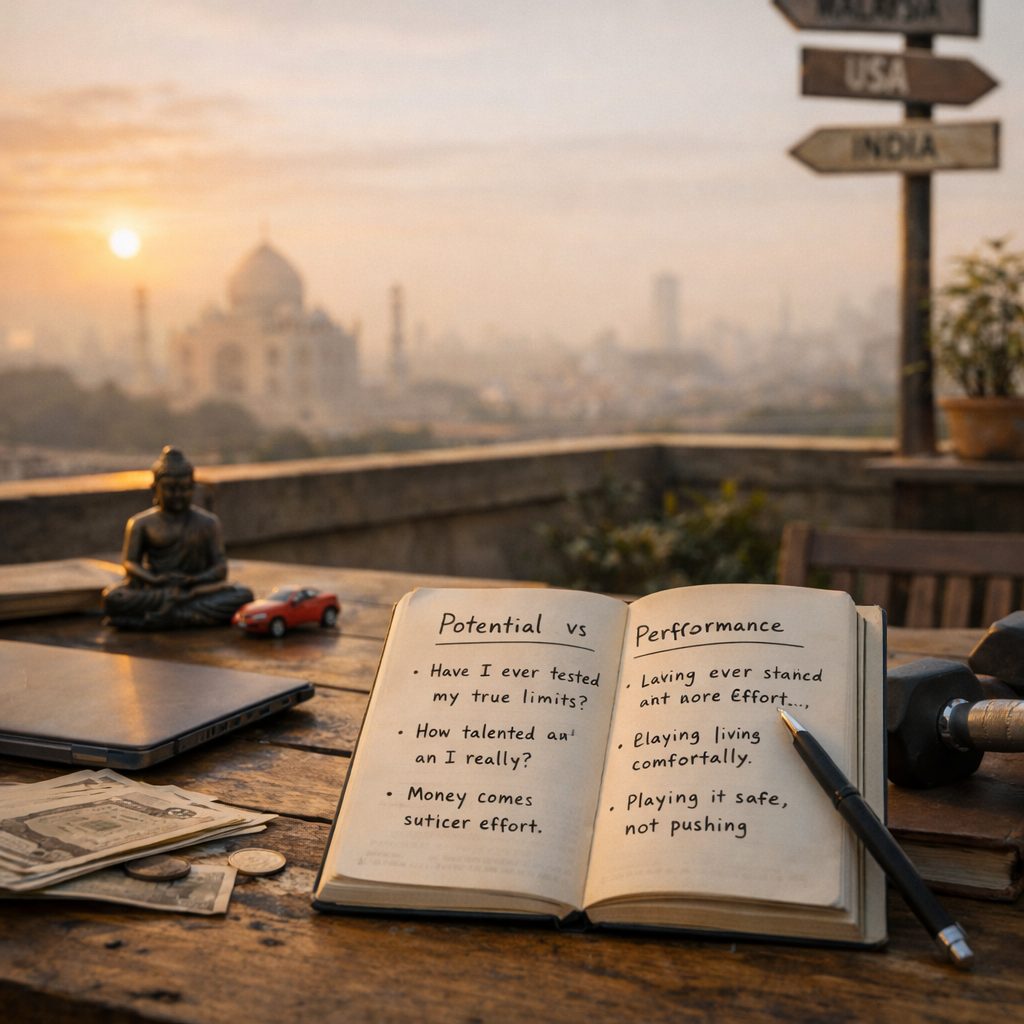
PS: This is Chat GPT’s blog version of notes and transcripts from a conversation with a friend.