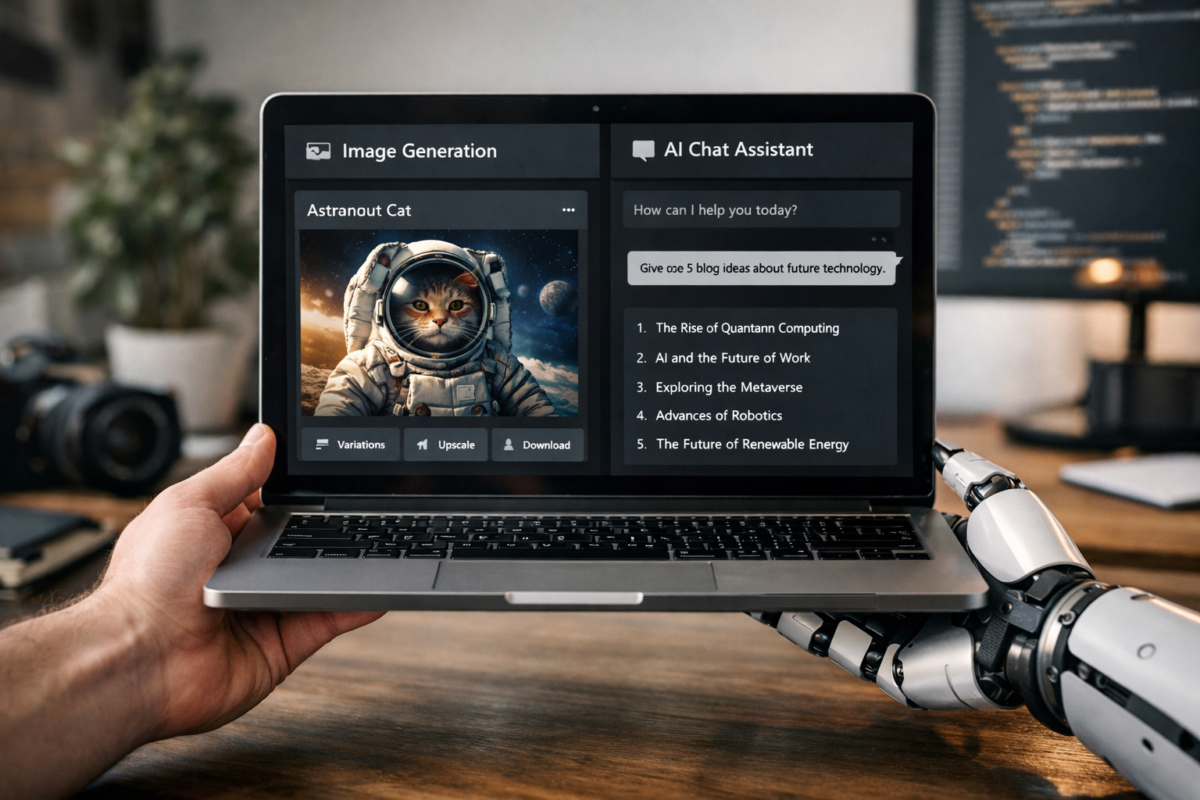
A ground-up rewrite of my 2023 post. Because in three years, everything and nothing has changed.
TL;DR
Freelancing in India in 2026 is a barbell market. AI has commoditised the bottom — basic copy, logos, data entry, entry-level code — and raised the premium at the top, where judgment, taste, relationships, and orchestration live. The specialist moat is shrinking; the thoughtful generalist is rising. The most useful things you can do if you’re starting today: play a 10-year game, build real relationships, price for value not hours, be reliable to the point of being boring, use AI like a senior team member (not a mere ghostwriter), and get discoverable on both Google and ChatGPT / Perplexity / Claude. The whole post below unpacks each of these, plus the India-specific tax, legal, and platform plumbing you need.
A short prologue
In 2015, I quit my job as a digital strategy planner at a social media agency. I barely scraped through the first two years.
By 2022, as I wrote in my earlier post, I was billing roughly 10 lakhs a month as a collective. Good months: 22 lakhs. Bad months: 4.
Today, end of April 2026, The C4E Collective is far more stable as a business. Most of if happened because of the clients we serve, and the systems we’ve slowly built. I still don’t know what we’ll bill next month. I’m still making it up as I go. I still have days where I wonder what the hell I’m doing.
So. If I’m being honest, not much has changed on the inside.
On the outside, though? Everything.
In the last 36 months, ChatGPT ate homework and then ate work. Claude started writing production code. Midjourney put stock photo sites on life support. An Indian 22-year-old with a laptop and Cursor can now ship what used to take a 12-person agency. Perplexity replaced Google for research. Fiverr’s bottom fell out. LinkedIn became 80% AI-generated. Content writers are terrified. Designers are anxious. Coders are pretending not to be anxious.
And somewhere in all this noise, a quiet thing is happening: the freelancers I know who are doing best — not the influencers on Twitter, but actual billing-real-money freelancers — are doing better than in 2023. Not because they picked the right AI tool. Because they picked the right game to play.
This post is about that game. For Indians. In 2026.
PS: Like everything I write, this is a summary of what’s worked for me and a handful of people I’ve watched closely. It is emphatically not universal gyaan. Please adapt. Please disagree. Please tell me what I got wrong.
What actually changed between 2023 and 2026
Before we get to the lessons, let’s be honest about what broke.
Content writing rates collapsed. A 2024 academic paper by Demirci, Hannane, and Zhu looked at millions of job postings on a leading global freelance platform and found a 21% decrease in automation-prone jobs (writing and coding combined) within 8 months of ChatGPT’s launch. A follow-up study by Teutloff et al. (2025) in the Journal of Economic Behavior & Organization put the figure higher for substitutable skills specifically — writing and translation demand dropped by 20–50% depending on the cluster, with the sharpest falls in short-term gigs. A 2025 ProCopywriters survey found 43% of copywriters were “very concerned” about AI’s impact on their earnings. The people I know who wrote SEO blog posts for 2 rupees a word in 2022 now write them for 50 paise. Or they’ve quit.
Basic design got cheap. Logo gigs on Fiverr that used to be $50 now routinely go for $5, because the seller is running Midjourney or Ideogram and charging a markup. Same for standard social media posts, thumbnails, and simple illustration.
Entry-level code became free-ish. Cursor, Claude Code, Lovable, Bolt, and v0 can now ship working apps in hours. Simple bug fixes, CRUD apps, WordPress tweaks, landing pages — a category that paid Indian juniors a steady 40-80k/month in 2022 — is being eaten from both sides: the client just prompts it themselves, or the “freelancer” is just a thin wrapper over a tool.
Client behaviour changed. Clients now arrive with a draft. They’ve already been to ChatGPT. They’ve seen a mediocre version of what they want. Your job is not to make the thing anymore; it’s to make the thing better than the AI did. The bar moved.
Platform economics shifted. On Fiverr and Upwork, commodity categories — basic copy, logos, data entry — have shrunk as “AI-augmented” sellers flood in with 10x volume and 10x lower prices. Upwork responded by leaning into its “strategic talent” positioning and launching its own AI assistant (Uma) to help freelancers draft proposals and compete. The premium is real. The bottom is in free fall.
Now for the less-talked-about part.
Top-end rates went up. The same ProCopywriters survey showed a 9% annual rise in fees at the top end. PwC’s 2025 Global AI Jobs Barometer, analysing nearly a billion job ads across six continents, found workers with AI skills command a 56% wage premium — up from 25% the previous year — in comparable roles. A 2025 study of 250 senior tech leaders by A.Team with Riviera Partners found that 92% of them expect to increase their engagements with freelance or fractional talent in the next 24 months; blended teams with freelancers were twice as likely to successfully ship AI to production. McKinsey’s State of AI 2025 confirms the pattern at the enterprise level: AI is decreasing demand for specific tasks, not for people who can orchestrate outcomes.
The middle hollowed out. Freelancing in 2026, in India and globally, is a barbell. Cheap AI-augmented volume at one end. Expensive AI-augmented judgment at the other. And between them, a shrinking middle that is where most freelancers actually live. The goal of this post is simple: to help you skip the middle.
Let’s go.
Lesson 0 — Freelancing is a 10-year game. AI just made it a harder one to shortcut.
Why is freelancing still a long-term game in the AI era?
This was also Lesson 0 in 2023. I’m repeating it because it’s more true now, not less.
Freelancing is a long-term game you play with long-term people. Every paying client I have in April 2026 is someone I’ve known for at least 2 years. Most for 5+. A few for 10+. The three biggest clients on C4E’s books right now all trace back to relationships I started before COVID.
The instinct, when AI arrives, is to assume the game got shorter. That you can now vibe-code an app in a weekend, post it on Twitter, get a flood of clients, and retire. It’s a nice fantasy. It is not what happens.
What actually happens: AI made tasks shorter. Relationships, trust, judgment, and taste still take exactly as long as they did in 2015. Your WhatsApp group of 200 marketers is not going to become 200 clients in 3 months. It might become 4 clients in 3 years. And those 4 will refer another 6 over the next 7 years. That is the game.
So before we go any further: please get this tattooed on your forehead. Freelancing in 2026 is a 10-year game. AI compresses the work, not the market. Relationships compound the same way they did in 2015.
The good news: if you start today and commit to playing for 10 years, you will have a massive edge over the 90% of people who will try freelancing for 8 months, get frustrated, and take a job. Most of the competition is temporary.
PS: The keyword is commit. Without that, nothing else in this post will work. Not the right tools. Not the right niche. Not the right city. Commitment is the moat.
Lesson 1 — Be a generalist. Yes, even now. Especially now.
Should I specialize or be a generalist as a freelancer in 2026?
I know. Every guru on LinkedIn is telling you to specialize. Find a niche. Become the “X for Y” person. Go one inch wide, one mile deep.
I want you to ignore all of them.
Here’s the contrarian case, and it’s supported by the data: specialization was the right move when execution was scarce. When only a trained developer could build a web app, being “the best Django developer in Bangalore” was a lucrative niche. In 2026, the client is building the Django app herself using Claude Code. The specialist is not replacing the generalist. The AI is replacing the specialist.
The World Economic Forum’s Future of Jobs Report 2025 put numbers to this: nearly 40% of core skills required by employers are expected to change by 2030, with “creative thinking,” “resilience, flexibility and agility,” and “curiosity and lifelong learning” rising fastest alongside AI literacy. These are not specialist traits. These are generalist traits. A recent piece in Built In cited data showing certain specialized technical roles still command a wage premium — but the author also admitted most workers with AI skills aren’t specialists at all. They’re generalists who learned to orchestrate.
Look at what I actually do, today, on a normal Tuesday:
- Marketing strategy for a precision oncology startup
- A shareholder letter for a founder friend
- A 52-week plan for a sports-tech client
- A script for a short ad film
- Notes on a book manuscript
- A pitch deck review
- Investor updates for a portfolio company
- A screenwriting app I built for myself that’s now a side project
I’m not the best in the world at any of these. I’m not even best-in-India at most of them. I am, however, annoyingly useful across all of them — and more importantly, I can connect the dots between them in a way that a specialist can’t. The oncology founder wanted a doctor-focused brand. The sports-tech client needed a founder-led content strategy. Those are not unrelated problems. They’re the same problem — how does a technical founder become a voice in their category — with different surface areas.
The generalist, in the AI era, is the one who sees the surface area.
Specialists execute tasks. AIs now do that faster. Generalists decide which tasks are worth doing, in what order, with what trade-offs, and tied to what larger story. AIs cannot (yet) do that well — because they don’t have skin in your client’s game. You do.
A practical framing I keep coming back to: be a T-shape where the horizontal bar of the T is wide, and the vertical bar is taste, not a skill. The horizontal bar is what you know and can do. The vertical bar is what you care about enough to have a point of view. Clients in 2026 are paying for the vertical bar. Because the horizontal bar — the doing — is mostly table stakes now.
PS: There is one exception. Truly deep specialists in narrow high-stakes fields — HIPAA-compliant AI systems for Indian hospitals, FSSAI-compliant nutraceutical formulation writing, SEBI-compliant fintech content — still print money. If you are that person, ignore this lesson. Most of us aren’t. Most of us should go wide.
Lesson 2 — Build relationships. They’re the last AI-proof moat.
How do I build a network as a freelancer in 2026?
The whole of Lesson 1 in my 2023 post was about this. The post on Loose Connections I wrote later is also worth reading. Re-read them both if you haven’t. They still hold.
A relationship, in freelancing terms, is a person who would take your call on a bad day and who would text a friend to say you should hire this person without being asked. AI cannot generate this. AI cannot replicate this. AI cannot even do a good job of imitating it in a LinkedIn DM — although it is trying, very hard, and you should not participate in that arms race.
How you build these is unchanged from 2023: you offer value first. You listen without expecting anything. You show up when it’s not your turn. You follow up when the project is over. You remember people’s kids’ names. You don’t treat anyone as a “lead.” You play the long game and the very long game and the even longer game.
What’s different in 2026:
1. The noise ratio is 10x worse. Every inbox is 80% AI-generated slop. Every LinkedIn DM is a templated “Hi Saurabh, loved your post on X, would love to jump on a quick call.” Every cold email starts with “I noticed you’re doing great work at C4E.” Nobody reads any of this. The signal-to-noise ratio is abysmal.
Which means: a handwritten, specific, non-ask message now cuts through in a way it never did. If you send me a WhatsApp that says “Saurabh, I read your piece on loose connections, here’s a thing I disagreed with, also I grew up in Bhopal too,” I will read it. I will probably reply. If you send me “Hi Saurabh, would love to jump on a quick call,” I will not.
2. Second-order networks matter more. Because AI has made information cheap, the value of introductions has gone up. Your network isn’t just your first-degree contacts anymore. It’s who they can introduce you to. And that happens only if they trust you enough to spend their social capital. Earn that trust slowly.
3. In-person is a massive unlock. When almost every digital interaction is mediated or augmented or automated, physically showing up at an event, walking up to someone, and having a 10-minute conversation about nothing in particular is disproportionately powerful. It is also the thing most freelancers, especially introverts and especially in India where “networking” feels dirty, are worst at.
In India, specifically: Go to Nasscom events. Go to any marketing/advertising meetup in Mumbai, Bangalore, Delhi, or Gurgaon. Show up at Momentum. Join the right WhatsApp groups (I run one on marketing — add yourself). Take a table at WeWork or 91Springboard or BHIVE for a month. Buy coffees for 30 people. Do nothing transactional. Watch what happens in 18 months.
PS: This is also the lesson I keep failing at. I still prefer working from my laptop at 2 am in Goa. I still find “networking” cringey. I still have to force myself. The difference between me and people who are better at this than me is not talent. It’s that they do it anyway.
Lesson 3 — Don’t wait for serendipity. Manufacture it. (And AI can help.)
How do I find freelance clients without platforms?
The WeWork story I told in the 2023 post is still my go-to: I overheard someone (Aditya Save) talking marketing on a call, walked up, introduced myself, we became friends, and he has since given me work, taken my input on his work, and stayed a loose-tied collaborator for seven years. None of that would have happened if I’d stayed at my own desk with headphones on.
In 2026, the “WeWork” equivalents are everywhere. You don’t need a co-working membership. You need to put yourself in places where people a level above you hang out. Some cheap tactical ideas:
Twitter/X DMs still work. Find 10 people whose work you’ve genuinely engaged with for 6+ months. Send them a specific, non-ask message. One in three will reply. One in ten will become a loose connection.
Reply under posts, not in DMs. If you leave a thoughtful reply on someone’s post for three months in a row, they will recognize your name. That’s the entry ticket.
Write your own thing. I know this is a cliché now. But a blog or newsletter — even one nobody reads — is a discovery surface. People will find you through it in 2 years. I promise. (See my 30 Minutes of Writing category for why I believe in this.)
Ship small public things. Not a SaaS. A weekend project. A landing page. A tiny tool. It signals that you can execute. Executing is now a more visible flex than talking.
Where AI genuinely helps:
- Perplexity for researching who’s who in a new industry — in 10 minutes, I can know the main players, controversies, and open problems in say, Indian edtech or GCC femtech.
- Claude Projects or ChatGPT Projects for maintaining a “people file” — notes on everyone you’ve met, searchable, summarizable.
- Granola for meeting notes (or its dozen competitors) — so you can actually follow up with specifics three weeks later.
- LinkedIn Premium + AI search for finding second-degree connections.
Where AI genuinely hurts:
- Any automated outreach. It’s dead. It looks dead. It smells dead. If you’re using Instantly, Smartlead, or an AI SDR to send cold emails, you are, to be very blunt, part of the problem. Stop.
- Generic thought-leadership posts written by ChatGPT. Your audience can tell. Even when they can’t tell, it doesn’t make them trust you.
Manufacture serendipity. But manufacture it by hand.
Lesson 4 — Be reliable. But know that reliability is now the floor, not the ceiling.
What does it mean to be a reliable freelancer in the AI era?
In 2023, reliability was a differentiator. “Saurabh replies to his emails” was, embarrassingly, a thing people paid for.
In 2026, reliability is table stakes. Because the benchmark is no longer other humans. The benchmark is an AI agent that replies in 400 milliseconds, never forgets context, never takes a sick day, and bills $2/hour. If your value proposition is “I show up on time,” you are competing against software that shows up before you do.
The floor moved. Here’s the new floor:
You respond within 2 business hours (not 24). In Indian business WhatsApp, the expectation is 30 minutes.
You keep a changelog of what you’ve done. Either in Notion, in an email summary, or inside the Google Doc itself. Clients in 2026 expect visibility into your process, not just the output.
You communicate about delays before they happen. Nothing kills trust faster than a silent miss. An AI will never miss a deadline without warning. You shouldn’t either.
You never lie about what you did vs what AI did. More on this under trust — but this is also a reliability question. Clients are learning to spot AI output. If you present something as “handcrafted” that’s 80% Claude, you will be caught eventually, and you will lose the client for life.
So what’s the new ceiling?
The new ceiling is judgment. You are reliable AND you caught the thing the AI missed. You are reliable AND you argued back against the client’s brief when their strategy was off. You are reliable AND you suggested a second deliverable they hadn’t thought of. Reliability was “I do what you asked.” The new ceiling is “I did what you asked, and here’s what you should actually have asked for.”
This is a subtle but expensive upgrade. It requires you to think. AI can’t do that part yet. And it’s the whole game now.
Lesson 5 — Start small. But price for value, not for hours.
How should I price my freelance work in 2026?
In the 2023 post, I wrote about a designer we engaged at ₹500 for an FB post. Today, he pays his home EMI from what we bill him. He started small and stayed reliable and kept widening.
All of that still applies. Start where you are. Take the cheap gig. Don’t hold out for 1 lakh when you should be taking 5k. Execution reputation is built one delivery at a time.
What’s different:
The hourly billing model is in trouble. Because hours no longer correlate with value. A freelancer in 2022 spent 8 hours writing a 1,500 word brand brief. A freelancer in 2026 spends 45 minutes on the same brief, 30 of which are thinking and 15 prompting. If you charge hourly, you just took a 90% pay cut on yourself.
Price for outcome, not for input. This is hard if you’re starting out, because you don’t yet have a reference for what your work is worth. But even early on, try to quote per deliverable. ₹8,000 for a two-page brand brief. ₹15,000 for a 1,500-word long-form article. ₹40,000 for a landing page with hero copy + three variants. Charge for the thing. Not the minutes.
Use the “No” rule for pricing. A rule I first saw in the Double Your Freelancing newsletter and have since seen Upwork and Fiverr’s blogs quote: raise your price until 50% of prospects say no. If everyone says yes, you’re under-priced. If everyone says no, you’re over-priced. 50% feels right. You will be uncomfortable reaching that number. Do it anyway.
For India specifically: Indian clients, especially in D2C, SMB, and startup land, are trained by Fiverr to think in small numbers. This is not your fault and it is also not your problem. Your job is to either price for them (small) or not work with them (bigger clients exist). Do not take a ₹3,000 project from a ₹3-crore brand “to build the relationship.” It builds the wrong relationship.
Billing in USD whenever possible. If you can work with clients overseas — US, UK, EU, Gulf — do it. Even at the low end, USD rates are 3–5x higher than INR rates for identical work. This one change is the biggest single unlock for Indian freelancers. More on the LUT/GST logistics later.
PS: None of this is new. Naval Ravikant has been writing this for years. Nivi has been writing it. Paul Graham wrote it in 2005. The only thing new in 2026 is: the gap between hourly billers and value billers is now much wider, and it’s widening fast.
Lesson 6 — Overdeliver. You have 10x leverage now — use it.
How do I stand out as a freelancer when AI can do the basics?
In 2023 I said: when you’re asked to write a blog post, send along three tweets to help distribute it. Give a bonus insight. Throw in the meta description.
In 2026, with AI leverage, you have no excuse not to do this for every single project.
A blog post I wrote for a client in 2022 took me 4 hours to produce. In 2026, the same post takes maybe 90 minutes. So what am I doing with the other 150 minutes? Two things: (1) thinking longer about the framing, the angle, the audience, the positioning — which is the part AI can’t do — and (2) shipping extras.
What “extras” look like in 2026:
- The core deliverable (blog post, deck, campaign, whatever)
- Plus: 5 social captions for the client to distribute it
- Plus: 3 alternate headlines A/B ready
- Plus: a short note on who this piece is targeting and why
- Plus: a follow-up email sequence if it’s a lead-gen piece
- Plus: a 90-second summary video script if they want to repurpose
- Plus: meta description, FAQ section, schema suggestions (helps with AI search — see Lesson 8)
That used to be 4 freelancers’ worth of work. Now it’s one freelancer with a stack. You, with your stack, are the 4-person team you couldn’t afford.
Clients will notice. Clients will tell other clients. Clients will stop asking for quotes from competitors.
The trap: don’t use the AI leverage to take more clients. Use it to deliver more per client. This is the difference between commodity volume (the race to the bottom) and premium depth (the thing you actually want). If you take on 3x more clients at the same rates, you’ve just become a more efficient hamster. If you deliver 3x more per client at 2x the rate, you’ve just become essential.
Lesson 7 — Use AI like a senior team member. Not a ghostwriter. Not a crutch.
What AI tools should a freelancer actually use in 2026?
OK, the AI tools section. Here’s my current stack. I am not a shill for any of these — and if any of this changes by the time you read it, assume I’ve moved on. (I keep a more detailed running list on my Tools of Trade page.)
Large language models (the workhorses):
- Claude (Anthropic) — my primary. Best long-form writing, best reasoning, best at holding voice. I use Claude Projects for every long-running client where I want persistent context.
- ChatGPT (OpenAI) — second. Better for quick drafts, Deep Research, and image generation via GPT-4 image models. Their Projects + Custom GPTs are solid.
- Gemini (Google) — I use it mainly inside Workspace — especially in Google Sheets and Docs for quick in-place edits.
- DeepSeek (Chinese open-weight) — I dip into DeepSeek R1 for technical reasoning tasks and for things where I don’t want the output going through an American model. Also, impressively cheap if you’re running through an API.
- Grok (xAI) — occasional. Useful for real-time Twitter/X context. I don’t use it daily.
Agentic / orchestration:
- Manus (Chinese multi-agent) — for multi-step research and workflow automation. I’ve been testing it on boring research-heavy work. Early but impressive.
- Claude Code (in the terminal) — my primary coding agent. It shipped both Scriptorial (a screenwriting app I built for myself) and FilmScriptWriter without me writing much code at all.
- Cursor and Windsurf — IDE-based AI coding. Cursor is the current champion, but this category changes every 3 months.
- Lovable, v0 (Vercel), Bolt — for rapid prototyping of web apps. Lovable is what I’d recommend to a non-coder in 2026.
Research:
- Perplexity — my primary search engine now. If I want to understand a new industry in 20 minutes, Perplexity.
- ChatGPT Deep Research and Claude Research — for longer, report-length research. Both good.
- Google AI Mode — getting scary-good. It’s where I start fact-checks.
Design / visuals:
- Midjourney — still the aesthetic leader. I use it for moodboarding, concept art, thumbnails.
- Ideogram — best for typography and designs that need real text. Better than Midjourney for anything with words in the image.
- Flux — for variations and control.
- Adobe Firefly — inside the Adobe suite, for in-workflow generation.
- Recraft — for vector and logo work.
- Canva + Canva Magic — what I hand to clients to use themselves.
Video / audio:
- Runway and Pika and Luma — for short AI video. Rapidly converging.
- Sora — still catching up on availability in India.
- Kling — the Chinese AI video tool. Very good.
- ElevenLabs — voice cloning and voiceover. Industry standard.
- Descript — podcast editing + transcription + AI rewrite.
India-made / India-focused (though am not a big fan of either):
- Krutrim (Ola) — Indian LLM. Promising; useful for regional-language work (Hindi, Tamil, Telugu, etc.).
- Sarvam AI — India-focused foundation models, especially good for Indic languages. Worth knowing.
The principle: don’t build on one tool. Build on a stack.
AI tools are like employees. You wouldn’t bet your business on one employee. Don’t bet it on one model. Every major project I do touches 3–5 of these tools. One for research. One for drafting. One for editing. One for visuals. One for delivery. Over time, you develop a muscle for which tool is good at what — and that orchestration skill, honestly, is now a bigger moat than any single “prompt engineering” skill everyone was selling in 2023.
One more thing: build your own tools.
I’ve built three small tools in the last 18 months — a screenwriting app, a script editor, and a Meta Ad Library competitive intelligence scraper — none of which pay me directly, and all of which I use daily with clients. The combined time I spent building them: maybe 40 hours total. The combined value to my client work: incalculable.
In 2026, if you are a freelancer, you should be able to vibe-code a small tool. Not a business. Just a tool. An invoicing helper. A brief generator. A portfolio site. A scraper. Something tiny that sits between you and the problem. The bar is low now. Use it.
PS: I’m not a developer. I can barely hold a for-loop in my head. If I can build tools in 2026, you can too.
Lesson 8 — Be discoverable on Google and on LLMs. This is new.
What is AEO and how do freelancers get cited by ChatGPT and Perplexity?
In 2023, “discoverable” meant: blog, newsletter, Twitter, LinkedIn. Google was the main discovery engine.
In 2026, Google is still a discovery engine — but it’s no longer the only one. Gartner predicts that traditional search volume will drop 25% by 2026 because users are moving to AI-powered answer engines. ChatGPT alone has 400–800 million weekly active users. Perplexity is cited by millions of users daily. Google’s own AI Overviews now appear in nearly 55% of US searches, and roughly 60% of Google searches already end without the user clicking any result.
Your clients are no longer just Googling “best brand strategist Bangalore.” They’re asking Claude, ChatGPT, or Perplexity “who’s a good fractional CMO in India for a mid-stage D2C brand?”
Your job is to be the answer to that question.
This is called Answer Engine Optimization (AEO) or Generative Engine Optimization (GEO) — different names for the same discipline. If you are a freelancer and you don’t understand this in 2026, you are invisible to an increasing share of your potential clients. Here’s the working playbook. (If you want a deeper dive, my Personal Branding 101 post has the foundational frame; this section is what I’d add to it in 2026.)
1. Be a named entity. Consistently.
Use your full name the same way everywhere. Saurabh Garg. Not Saurabh G., not sgarg, not @saurabh everywhere. Same bio on every platform. Same photograph. Same company name (The C4E Collective, not “C4E”, not “C4E Collective Pvt Ltd” in one place and “c4e” in another). AI models build entity knowledge graphs. You want to be a clear, recognizable node on theirs.
2. Have a personal site. Own your domain.
If you don’t have one, buy yourself-your-name-dot-com this weekend. Put up a page. It doesn’t have to be fancy. A few paragraphs about who you are, what you do, who you work with, and how to reach you. This page will be cited by AI engines when someone asks about you. Don’t outsource this to LinkedIn.
3. Write answers to the specific questions your potential clients are asking.
If you are a freelance video editor in Mumbai, one of the best things you can do is write a blog post titled “How much does a freelance video editor charge in Mumbai in 2026?” and actually answer it. Give numbers. Be specific. Self-contained paragraphs. AI engines love extractable answers. A good structure: question as H2, 2–5 sentences of answer directly below, then expansion.
4. Use FAQ schema.
It sounds technical. It isn’t. A simple FAQ block at the end of any post, marked up with FAQPage schema in JSON-LD, signals to AI engines that you’ve formatted your content for extraction. WordPress plugins like Yoast, Rank Math, and AIOSEO all do this for you automatically. (See the FAQ section at the bottom of this post — I’ve included a schema block you can copy if you’re publishing something similar.)
5. Live where AI models crawl.
This part surprises most people. Perplexity, in particular, cites Reddit disproportionately — roughly 46% of Perplexity’s top-10 cited sources are Reddit threads, according to 2026 analyses. ChatGPT and Claude both weigh YouTube transcripts heavily. Wikipedia, Medium, Substack, and quality industry sites also feed training data and live retrieval.
Tactical: find the 2 or 3 subreddits in your niche, contribute genuine value for 6 months (no links, no self-promo, actual help), and you will show up in AI-generated answers for months to come. Then occasionally link your work when it’s genuinely relevant. This is a 6-month play, not a 6-week one.
6. YouTube is massively underused by freelancers.
AI engines extract information from video transcripts. And the long tail of specific questions on YouTube — “how to structure a retainer for a fractional CMO in India” — is almost empty. Fill it. Even a basic 5-minute unedited Loom-style video with a clean transcript will outrank most of your written competition in AI answers for years.
7. Get cited by others.
If your name appears in guest posts, podcasts, industry reports, and forums as an authority on X, AI engines learn the association. One podcast interview where the host says “here’s Saurabh Garg, who runs C4E and works on fractional CMO work” is worth ten self-made blog posts.
The big shift to internalize: SEO was about clicks. AEO is about citations. Even if nobody clicks through, if Perplexity or ChatGPT cite you as a source, you’ve won. The user might never visit your site, but they will remember your name. And when they need that service, you’re top-of-mind. Citation is the new ranking.
Lesson 9 — Collaborate. The solo AI-powered freelancer is (mostly) a myth.
Should I freelance solo or join a collective?
Twitter is full of “one-person unicorns” running “AI-powered micro-agencies” and doing $500k ARR solo. A handful of them are real. Most are marketing. And even the real ones are almost always (a) a founder who raised money earlier, (b) a creator with an existing audience, or (c) someone whose “solo” actually means “me plus two offshore contractors I don’t mention.”
The default, boring, un-sexy truth: almost every freelancer making real money in 2026 is part of some collective, crew, or loose partnership.
Why:
- Clients want depth you don’t have alone. You will always need a designer, a developer, a researcher, a voice, a video editor — even if AI gives you 80%.
- You’ll get sick. You’ll travel. You’ll have a bad month.
- Bigger projects require bigger teams. You can’t pitch a ₹30-lakh retainer as one person; you can as a collective of four.
- You’ll burn out. Solo freelancing is lonely. Even with Claude. Especially with Claude.
What C4E actually is: 6–8 people, not employees, not shareholders (technically, though some may become so), not exactly contractors either. We work together on client retainers, split revenue loosely, and maintain each other’s standards. When a client comes to me, they’re not hiring Saurabh. They’re hiring the network. (I’ve written more about how we operate in What the heck is C4E? if you’re curious.)
How to start a collective (if you don’t have one):
- Identify 3–5 people whose work you admire and whose integrity you trust.
- Work on one shared project. Low stakes. See if you actually work well together.
- If yes, do another. Then another.
- At some point — usually 12–18 months in — it becomes obvious this is a collective.
- Don’t over-formalize too early. No LLP, no equity splits, no org chart. Just people who work together.
If you don’t know where to start, DM me. I’m still a tweet away. I often introduce people who should be working together.
Lesson 10 — Be the easiest freelancer to work with.
What do clients actually value in a freelancer in 2026?
This was Lesson 8 in 2023. I have nothing new to add. Copy-paste:
Clients are people. People like working with other people who are easy. Not most-skilled. Not best-in-world. Not even most-senior. Easy.
Easy means:
- You reply fast.
- You don’t ask a million questions; you make defensible decisions.
- You don’t argue when the client wants something dumb. You do it, and then you tell them why you’d have done it differently.
- You keep your ego at home.
- You don’t make things precious.
- You treat the client’s problem as your problem.
What’s new in 2026: clients are more stressed, more time-poor, more AI-overloaded than ever. The dopamine of being a low-maintenance, high-output collaborator is, if anything, worth more now. Being the easiest person on a client’s roster is a career strategy.
Lesson 11 — Be trustworthy. Especially now.
How do I build trust with clients in an AI-flooded market?
Trust was Lesson 9 in 2023. It’s now somewhere near the top.
Here’s why: in a world where content is abundant and attention is scarce, the scarcest commodity is knowing who is telling you the truth. Clients are drowning in decks, drafts, research reports, and “strategic frameworks” that all sound plausible because they were all written by the same three LLMs. The freelancer who can be relied on to tell the truth, even when it’s uncomfortable, is worth 10x what she was in 2023.
Specific in 2026:
1. Disclose your AI use. Not after the fact. Up front. “I’ll be using Claude for first drafts. I’ll be using Perplexity for research. I’ll be fact-checking myself. Here’s what I won’t use AI for.” This is unsettlingly rare. Clients appreciate it. It builds trust faster than anything else you can do.
2. Never present AI output as your judgment. This is the trust-killer of the decade. If a client asks “what should we do?” and you paste in a ChatGPT answer, they’ll feel it. Your job is to think and then present your thinking. Use AI to stress-test. Use it to explore. Don’t use it to avoid the work of deciding.
3. Be transparent about competitive conflicts. I still work for multiple agencies that compete with each other. I tell each of them. Every time. Nothing has ever gone wrong because of it. Several things have gone right because of it — clients trust me with more sensitive information, precisely because they know I won’t pretend I’m not working with their competitor.
4. Your zubaan has a keemat. This was Rajesh Sir’s lesson to me years ago and it’s a more valuable currency now than ever. When you commit to something, you do it. When you miss, you flag it before you miss. When you quote a price, you stick to it. When you say you’ll send a doc by Friday, Friday it is. This is, embarrassingly, a differentiator.
5. Be boringly, repetitively consistent. The compound interest of trust is the single most underrated asset class in freelancing. Every time you deliver on what you said, a tiny deposit is made in your client’s trust account. Do this for 5 years. Watch what happens.
Lesson 12 — Write in public. Not because it’s SEO. Because it builds you.
Why should freelancers still blog and write publicly in 2026?
In 2023, I said: write, blog, tweet, be discoverable. That’s the instrumental reason.
In 2026, there’s a more important reason: writing is how you figure out what you think. And in a world where thinking is the scarcest thing, figuring out what you think is the most valuable thing you can do.
A blog is cheap. A newsletter is cheap. A daily tweet is cheap. Put in 30 minutes a day for five years. Take on no opinions that aren’t yours. Write through your confusion until you’re less confused. Publish it all, even the bad stuff. Especially the bad stuff — it’s what makes you recognizable as a human and not a Claude wrapper.
I’ve been writing on saurabhgarg.com for 20+ years. I still suck at it. I still publish half-baked posts. I still have weeks where I miss. But the compound effect is absurd. Every single current client has, at some point, read something I wrote. That thing did the selling before I opened my mouth. (If you want a starting habit: 30 Minutes of Writing is the exact practice I’ve used for years.)
Specifically for 2026:
- Your blog is your résumé. Not LinkedIn. LinkedIn is pattern-matched AI slop now.
- Your blog is also your audition. Clients read 3–4 of your posts before they reach out. Your best post is your interview.
- Your blog is also training data. This is the new part. Every piece you publish gets crawled and (potentially) fed into the next training cycle of GPT, Claude, Gemini. When someone asks an AI engine “who’s a good marketing freelancer in India who understands X” and you’ve written 20 posts on X — the model may know you. In 2023, I would have called this weird. In 2026, it is a real phenomenon.
Write. Publish. Keep writing. It’s the cheapest, highest-leverage investment you can make in your career. And it compounds for decades.
The India-specific bit: money, tax, legal, logistics
What do I need to know about freelance taxes and legal setup in India in 2026?
Because freelancing in India has its own plumbing. Some of this changed recently. Some of it is just annoyingly specific. None of it is optional.
PAN + bank account + GST. You don’t need a company to start freelancing in India. A PAN card and a current account is enough. You become a sole proprietor automatically. GST registration becomes mandatory only if your annual turnover crosses ₹20 lakh (₹10 lakh in some north-eastern states). Below that, you’re GST-exempt.
GST registration. If you’re crossing ₹20L or you’re working with clients who demand GST invoices (many larger companies do), register anyway. Once you’re registered, you charge GST on domestic services (typically 18%), file returns monthly or quarterly, and claim input credits on business expenses (laptop, software subscriptions, internet).
LUT for exports. This is the unlock most Indian freelancers don’t know about. If you work with overseas clients, register for a Letter of Undertaking (LUT) with the GST department. LUT lets you bill international clients at 0% GST. Without it, you either eat the 18% GST on export invoices (you don’t) or claim refunds (painful). LUT is free, valid for a financial year, and applied online. Renew annually.
e-FIRA for inward remittance. When overseas payment lands in your account, your bank auto-generates an e-FIRA (electronic Foreign Inward Remittance Advice). This is your proof to the GST department that the income was an export. Keep it organized. You’ll need it.
Payment rails. In 2026, the main ways to get paid from overseas: Wise (formerly TransferWise), Payoneer, PayPal (rapidly losing share), direct wire, Stripe Atlas + US LLC (only if you’re scaling). For domestic: UPI, direct bank transfers. Invoices should have your GSTIN, SAC code (998314 for consultancy, 998311 for other professional services), and clear payment terms.
Income tax. File as a self-employed professional. Use the 44ADA presumptive taxation scheme if your gross receipts are under ₹75 lakh — it lets you declare 50% of gross as profit without maintaining books. Huge simplification. Above ₹75L you maintain books. Deductible expenses include internet, software, laptop depreciation, phone, home office electricity (proportional), travel for client work, and professional development.
New Labour Law 2026 — the social security bit. The government’s updated labour code extends some social security coverage to platform and gig workers in 2026, including access to certain health, accident, and old-age protections. This is still rolling out unevenly. If you’re earning significantly as a freelancer, you should register as a gig worker on the e-Shram portal and stay aware of updates. It’s not full employment benefits, but it’s more than zero.
Invoicing platforms. Zoho Invoice (free), Refrens (Indian-focused, good for freelancers), Razorpay for payment collection + invoicing, Stripe if you’re international-heavy. Pick one and stick with it.
Set aside tax. A rule-of-thumb: the moment an invoice is paid, move 30% to a separate account. Treat it as already-owed-to-the-government. Do not touch. Most freelancers blow up in March because they didn’t do this. Don’t be them.
Insurance. Term insurance if you have dependents. Health insurance for yourself (employer-provided options don’t exist for freelancers). Professional indemnity insurance if you’re in a high-liability field (legal, medical, financial). Most Indian freelancers ignore insurance entirely. This is a mistake that compounds.
PS: I’m not a CA. I am also definitely not a lawyer. Work with both.
Frequently asked questions
Is freelancing a real career in India in 2026?
Yes. India now has an estimated 12–15 million freelancers, projected to reach 23.5 million by 2030, with the gig workforce making up roughly 16% of India’s total workforce. The Indian freelance market is expected to touch $25 billion by 2026, with project-based hiring up 38% in FY25. It is no longer an unusual career path — it is becoming normal.
How much can I earn as a freelancer in India in 2026?
Beginners typically earn ₹10,000–₹30,000 per month in the first 6–12 months while building a portfolio. With 2–3 years of experience and a niche, ₹50,000–₹1.5 lakh per month is achievable. At the top end, freelancers running small collectives or billing overseas clients in USD earn ₹5–20 lakh per month or more. Income varies enormously based on skill, niche, clients, and whether you work with domestic or international clients.
Will AI replace freelancers by 2030?
AI will not replace freelancers. It will replace tasks. Specifically, AI has already commoditized basic content writing, simple design work, data entry, and entry-level coding. However, AI has also increased demand for specialized, fractional human talent — 92% of senior tech leaders in a 2025 A.Team / Riviera Partners study said they expect to increase their engagements with freelance or fractional talent in the next 24 months. Freelancers who combine AI tools with strategic thinking, client-specific judgment, and relationship management are earning significantly more than before. The ones who refused to adopt AI are struggling.
Should I specialize or be a generalist in 2026?
The contrarian case, which I believe in, is to be a generalist with taste. AI has made specialization cheap and orchestration scarce. Clients in 2026 increasingly need someone who can connect strategy, content, design, distribution, and measurement — not someone who only writes copy. That said, if you are in a high-stakes regulated niche (medical, legal, financial), deep specialization still commands premium rates. For most creative and marketing freelancers, go wide and get good at stitching.
What are the best freelancing platforms in India in 2026?
For international clients: Upwork, Contra, Toptal (vetted), and LinkedIn for direct outreach. For Indian clients: Truelancer, Freelancer.com, and Refrens. For creators and specialists: Fiverr (if you’re brave), Internshala (for students), Envato (for creatives). However, the highest-earning Indian freelancers in 2026 do not rely on platforms at all — they work with clients they met through their network, their writing, or referrals. Platforms are how you start. They are not how you scale.
Is freelancing legal in India? What about taxes?
Freelancing is fully legal in India. You only need a PAN card, a bank account, and a payment method. Register for GST if your annual turnover exceeds ₹20 lakh. For overseas clients, register for an LUT to bill at 0% GST on export services. File income tax annually as a self-employed professional — use the 44ADA presumptive scheme if your gross receipts are under ₹75 lakh for simpler books. The new Labour Law 2026 extends limited social security benefits to registered gig workers through the e-Shram portal.
How do I find my first freelance client in India?
Start with your existing network. Your college friends, former colleagues, family friends, and anyone who’s seen your work. Send personal, non-templated messages about a specific skill you’re now offering. Take the first project even if it pays poorly — execution reputation is built one delivery at a time. Simultaneously, start writing and shipping small public work on LinkedIn, Twitter, or your own blog. Most first freelance clients come from first-degree or second-degree connections in the first 6 months, not from cold outreach.
Should I charge hourly or per project?
Per project, almost always. Hourly billing is dying in 2026 because AI has decoupled time from value — a 4-hour task in 2022 may be a 30-minute task in 2026, which means hourly rates penalize you for using tools well. Price per deliverable, per outcome, or per retainer. Reserve hourly billing for genuinely unpredictable scopes like ongoing consulting calls.
What AI tools should a beginner freelancer learn in 2026?
Start with: Claude or ChatGPT (for writing, thinking, and communication), Perplexity (for research), Midjourney or Ideogram (if you need visuals), and one vibe-coding tool like Lovable or v0 (for building small tools). That’s five tools. Become genuinely fluent in those before adding more. Tool-hopping is a distraction; deep proficiency in a small stack is the real skill.
Can I freelance while I have a full-time job?
Yes, subject to your employment contract. Most Indian employment contracts have a “moonlighting” clause — read yours. If allowed, start slowly: one client, low-complexity work, strict boundaries on employer time and resources. Moonlighting is a common and legitimate first step to full-time freelancing, but be transparent with both sides. Do not use your employer’s laptop or systems.
How long does it take to go full-time as a freelancer?
Realistically, 18–36 months from “I want to do this” to “I can comfortably pay my bills and save.” The common pattern: 6 months of side hustling, 6 months of low-paid first clients, 6 months of building a portfolio and raising rates, and 12+ months of steady growth. Anyone selling you a “₹1 lakh per month in 90 days” plan in 2026 is selling you a course, not a career.
What’s the biggest mistake new freelancers make in 2026?
Competing on price. In 2026, there will always be someone cheaper — often an AI or an AI-augmented freelancer overseas. Competing on price is a death spiral. Compete on judgment, taste, reliability, and relationships — the things AI can’t replicate. Start small, yes. But never position yourself as the cheap option.
In the end
Three years ago, I wrote that post about freelancing in 2023. I expected it to age well. I did not expect the entire substrate — search engines, knowledge work, client expectations, the economics of creative services — to shift under our feet in 36 months. It did. It will keep shifting.
And yet, the actual lessons have not changed very much.
You play a long-term game. You build real relationships. You are reliable. You are useful. You don’t wait for serendipity — you manufacture it. You start small, charge for value, overdeliver, and keep your word. You write in public. You collaborate. You use the new tools without worshipping them. You tell the truth. You are the person clients want on their roster.
The only thing that’s genuinely new: the leverage. If you hold those principles steady, and you combine them with the absurd capabilities that AI now gives you, you become dangerous. Not dangerous like the bro on Twitter making $30k a month with his “AI agency.” Dangerous in the boring, compound-interest sense — where in year 7, you look up, and you’re running an 8-digit business without quite knowing how you got there.
I’ll probably write another one of these in 2029. If this ages badly, come tell me. If something I’ve said here worked for you, come tell me that too.
And if you’re starting today: welcome. It’s a good game. It rewards patience more than any other game I’ve played. And it is, despite everything AI has done, still a profoundly human game.
I’m still a tweet away. So is my DM. Most of the people who have become my clients started exactly there. If you’re thinking about working together, here’s how that usually starts.
Credits and disclaimers
- This post is a summary of what’s worked for me, my collaborators at C4E, and freelancers I’ve watched closely. Your mileage will vary. Please adapt.
- For context: I’ve been freelancing since 2015 after an MBA from MDI Gurgaon and several years in digital strategy.
- Key data sources referenced: Demirci, Hannane & Zhu (SSRN 2023) on automation-prone freelance jobs; Teutloff et al. (2025) in the Journal of Economic Behavior & Organization; ProCopywriters 2025 survey on copywriter sentiment; PwC 2025 Global AI Jobs Barometer on AI skills wage premium; McKinsey State of AI 2025 on enterprise AI adoption; A.Team 2025 AI research on tech leader hiring intentions; Gartner’s prediction on search volume decline; WEF Future of Jobs Report 2025. Indian freelancing market data from Spocket, WeWork India, Payoneer, and Razorpay reports.
- Thanks to everyone who’s given me work and read my drafts and pushed back on my bad ideas over the last 11 years. Too many to name without leaving someone out.
- I am not a lawyer, CA, or financial advisor. The tax and legal sections are correct to the best of my understanding in April 2026 but please verify with a professional. Laws change. Rates change. AI changes. Everything changes.
If you have questions I didn’t answer, DM me. Actually, let me know what you’d want in a Part 2 — I’m thinking about topics like “how to structure an AI-augmented retainer,” “how to build a small collective from scratch,” and “how to price when the client has already used ChatGPT.” Tell me what’s most useful.